The copper order comes before the first AI query
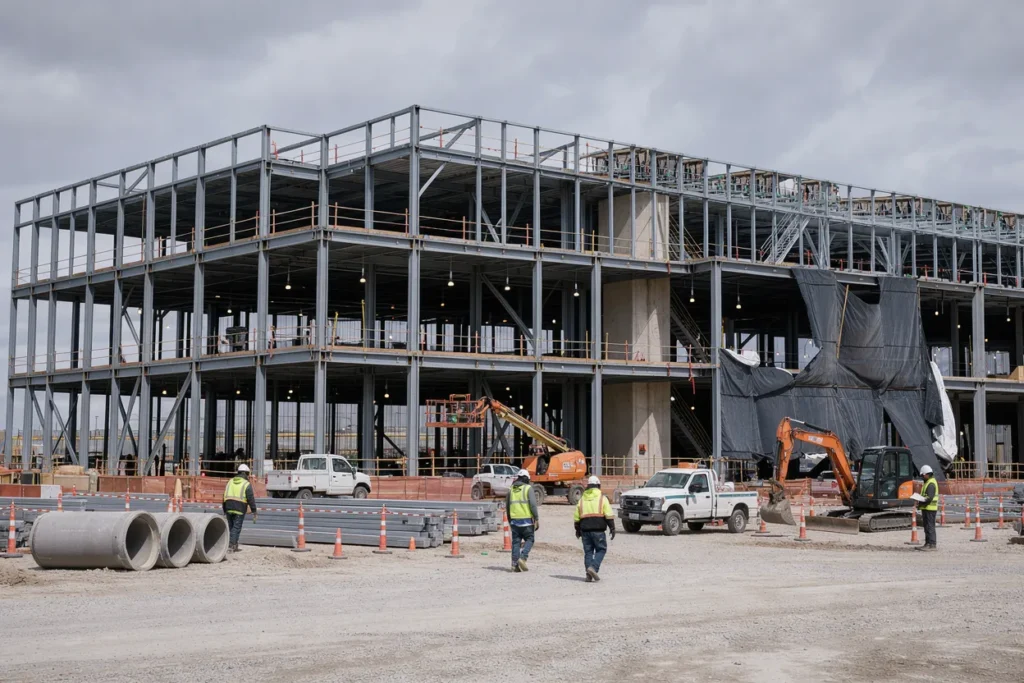
A data center becomes a metals story well before its servers start working.
Power must reach the site. Copper goes into cables, transformers and electrical equipment. By the time a customer rents computing capacity, parts of that physical investment have already been made.
That is the chain now being tested by Nvidia’s leadership crisis.
Nvidia (NASDAQ: NVDA) announced that Jensen Huang resigned as CEO, president and director, with CFO Colette Kress appointed interim CEO. The board expects operations, customer commitments and its product roadmap to continue without interruption.
Continuity is the company’s stated expectation. Customers and lenders will make their own assessments.
Commodity miners are exposed through the construction calendar. A loss of confidence can postpone equipment purchases and power projects, pushing metals demand into later years even when the eventual need for computing remains.
The spending plans are large, but their contents matter
The companies commissioning infrastructure still have substantial plans.
On its October 28 call, Microsoft (NASDAQ: MSFT) projected approximately $170 billion in calendar-year capital expenditure, with more than $50 billion expected in the December quarter.
Alphabet (NASDAQ: GOOGL) maintained its $195 billion–$205 billion annual spending forecast and anticipated a significant increase in 2027.
Both outlooks predate Huang’s departure. They establish the scale of planned investment, while leaving room for revisions.
There is another wrinkle for metals producers: a capital-spending budget is not a shopping list for copper.
Microsoft said roughly three-quarters of its latest quarterly capex went toward shorter-lived assets, primarily processors, including higher memory and storage costs. Alphabet allocated approximately 65% of quarterly technical-infrastructure investment to servers and networking, with the remainder going to data centers.
Those categories have different material requirements. Higher chip prices can inflate spending without producing a matching increase in metal consumption.
Conversely, a customer switching chip suppliers may still need a building, a cooling system and a grid connection. The more consequential change would be a smaller site—or a construction start moved back a year.
The next developments may surface in a power contract or a construction update before they appear in a miner’s results. Wall Street Access follows those connections across technology, energy and the companies supplying the build-out.
Track the Metals and Energy Behind AI’s Expansion
Copper has more than one source of growth
AI has given copper a compelling new story. The metal’s demand base is considerably wider.
S&P Global projects global copper consumption rising from 28 million metric tons in 2025 to 42 million in 2040. AI, data centers and associated power generation account for approximately 2 million tons of that increase.
That works out to about 14% of projected growth, or roughly one-seventh. Economic development and broader electrification remain the larger drivers.
An AI slowdown would therefore affect a meaningful addition to demand. It would leave other major sources of consumption in place.
Supply also has its own timetable. The same study puts average copper-mine development at approximately 17 years from discovery to production. A change in technology spending can happen much faster than a new mine can respond.
These are long-range projections, with substantial uncertainty. Their value here is perspective: copper’s outlook rests on several expanding industries alongside a slow and difficult supply response.
Confidence reaches miners through financing
There is a reason the stock-market shock still deserves attention.
The International Energy Agency warns that data-center investment increasingly requires capital-market funding beyond company balance sheets. That makes construction sensitive to expected returns and financing conditions.
Its outlook puts global data-center electricity consumption at approximately 950 terawatt-hours in 2030, roughly double 2025 levels. Delivering that growth requires physical projects to clear financing, equipment and grid constraints.
The distinction carries into nuclear power. Microsoft’s 20-year agreement supporting Constellation’s Crane restart backs a specific project, with 835 megawatts targeted for return in 2027. Its implications for fuel demand depend on the reactor’s restart and operation.
Nvidia’s November 17 results provide the next scheduled update on its business. For miners, the evidence will also come from customers maintaining construction dates, securing power and placing equipment orders.
A postponed substation can move copper purchases out of a financial year. Multiply that across a building program, and a change in technology sentiment can become a change in physical demand.
Explore More Stories in Commodities
Disclaimer
Wall Street Access is an independent financial publisher. Wall Street Access is not a financial advisor. No company mentioned has compensated Wall Street Access for the preparation, publication or distribution of this article. This content is provided for informational and educational purposes only and is not investment advice or a recommendation to buy, sell or hold any security. Investing involves risk, including the possible loss of principal.
Prices, market capitalizations, financial figures and other market data are based on information available as of the date and time of publication and may change without notice. Information is drawn from public sources believed to be reliable but is not guaranteed to be complete or accurate. Opinions and expectations expressed are our own and may change as new information becomes available.
Readers should conduct their own due diligence and contact a licensed financial professional before making any investment decision. Past performance does not guarantee future results. Any material ownership interest or conflict of interest, where applicable, will be disclosed separately.