
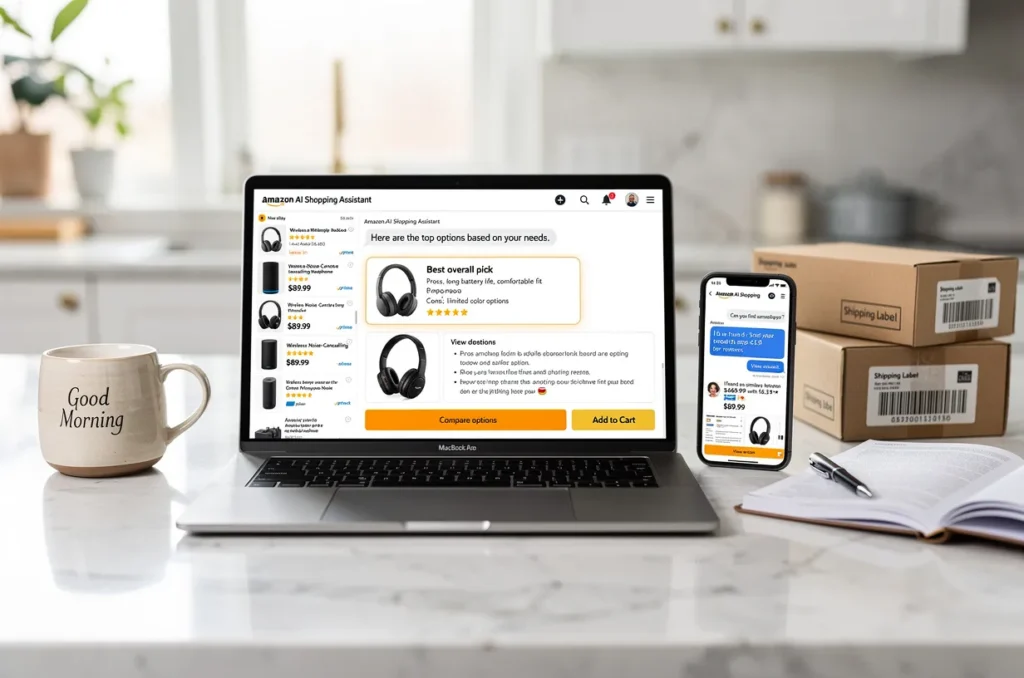
Amazon is taking one of its internal tools and turning it into a platform
Amazon has done this before.
First it built infrastructure for itself. Then it turned that infrastructure into a business other companies had to pay for. That was the story with AWS, and to a lesser extent with logistics, warehousing, and cashierless retail technology. Now Amazon is applying the same playbook to AI shopping.
According to the company, retailers can use the new AWS offering to launch branded AI shopping tools tailored to their own catalog, storefront, and customer experience in as little as 60 days. What Amazon is selling is not just a chatbot. It is the architecture, starter code, and operating lessons it developed internally through Alexa for Shopping.
That is a meaningful shift.
This is bigger than a feature launch
On the surface, this sounds like another AI product announcement. It is more important than that.
Amazon is not just trying to improve shopping on its own site. It is trying to position itself as the back-end provider for how other retailers deploy AI in commerce. That matters because if AI shopping becomes a real layer of online retail, the company that powers the tools may end up in an even stronger position than the company that owns the storefront.
This is where Amazon has always been dangerous. It rarely stops at being a participant in a market. It usually tries to become the system other participants rely on.
Alexa for Shopping is now the core commercial product
Earlier this month, Amazon rebranded its ecommerce chatbot from Rufus to Alexa for Shopping and turned it on by default in store search. That move already suggested the company was taking the product more seriously. Now the next step is obvious: commercialize it outside the Amazon store.
Offering the service through AWS is also strategic.
Plenty of retailers would be reluctant to share data or customer workflows directly with Amazon’s retail arm. Packaging the product under AWS helps soften that concern, at least somewhat, because AWS already has a long history of selling infrastructure to companies that also compete with Amazon in other ways.
That does not eliminate the trust issue. It does make the pitch more workable.
Amazon is making a direct play for control over the shopping layer
This is also part of a broader fight that is only getting more competitive.
OpenAI, Google, and Perplexity are all pushing into shopping research, recommendations, and purchase assistance. Retailers themselves are also experimenting with their own tools while balancing partnerships with outside AI providers. At the same time, software vendors like Salesforce are pitching retailers on AI agents and chatbot layers they can control directly.
Amazon’s answer is to argue that retailers should not hand over the shopping experience to a generic intermediary.
That is smart positioning. Amazon is effectively saying: use AI, but keep the customer relationship, product knowledge, and brand voice inside your own ecosystem. Then let Amazon supply the machinery underneath.
The first customer tells you where this may go
Amazon said Kate Spade, owned by Tapestry, has already used the product to launch a gifting assistant, with additional retailers still in testing.
That first example is revealing.
Luxury and gifting are both areas where AI-assisted product discovery can make a lot of sense. They are high-consideration categories, often dependent on curation, context, and narrowing choices. If Amazon’s tools work well there, the company will have a much easier time expanding into broader fashion, home, beauty, and specialty retail use cases.
That is where this could get interesting fast.
Retailers want AI, but not at the cost of control
One of the more important tensions in this story is control.
Retailers clearly want better AI tools. They also do not want to become interchangeable front ends sitting underneath someone else’s shopping assistant. That is why so many of them are taking a mixed approach:
- build some tools internally
- partner selectively with outside AI firms
- keep as much ownership of the customer experience as possible
Amazon’s pitch fits neatly into that mindset. It offers a faster AI path without forcing a retailer to surrender the whole shopping experience to a third-party agent.
Amazon is still playing offense while limiting others
There is another layer here too.
Amazon has been reluctant to partner deeply with rival AI platforms. It has also blocked external agents from scraping its site while building its own Buy for Me feature that can shop on other retailers’ websites for users. That tells you exactly how Amazon sees the battlefield.
It does not want outside AI platforms sitting between the shopper and the merchant. It wants Amazon-built systems to be that layer instead.
This product launch fits that strategy perfectly.
WSA Take
Amazon is not simply adding AI to retail. It is trying to own the infrastructure that lets retail use AI at scale.
That matters because the winners in this next phase of ecommerce may not just be the stores with the best front-end experience. They may also be the companies supplying the intelligence, workflows, and agentic tools underneath the surface. Amazon already understands that better than most.
This move looks like another classic Amazon expansion: solve an internal problem, productize the solution, then sell it to the rest of the market before competitors fully understand what game is being played.
Disclaimer
WallStAccess is a financial media platform providing market commentary and analysis for informational and educational purposes only. This content does not constitute investment advice, a recommendation, or an offer to buy or sell any securities. Readers should conduct their own research or consult a licensed financial professional before making investment decisions.