Apple is back in the megacap spotlight
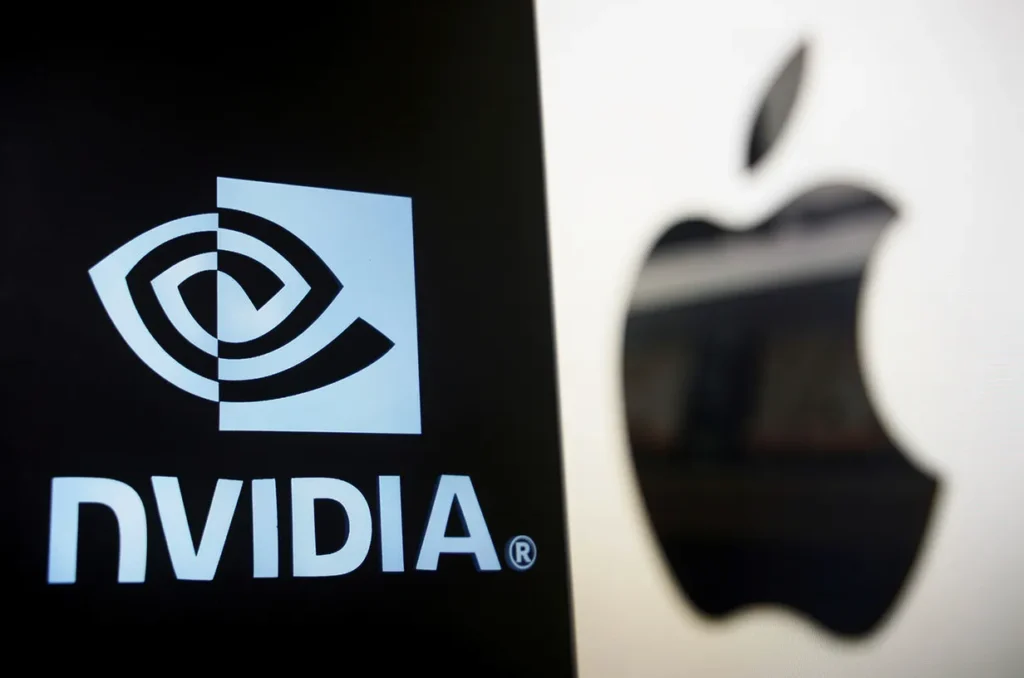
Apple and Nvidia traded places Friday in the race to become the world’s most valuable company, with Apple briefly moving ahead of the AI chip leader by market value.
Nvidia shares fell about 3% in early trading, pushing its market value down to roughly $4.84 trillion. Apple, meanwhile, hovered near $4.88 trillion before the positions later reversed.
The back-and-forth matters because the two companies now represent different sides of the artificial intelligence trade. Nvidia has been the dominant winner from the AI infrastructure boom, while Apple has been treated more cautiously because its AI strategy has taken longer to become visible.
That setup is changing.
Apple’s 2026 rally has shifted the comparison
Apple has gained 22% this year, outpacing Nvidia and reclaiming investor attention after a slower period for the stock.
The move has been driven by renewed confidence in Apple’s AI agenda, its product pipeline and its ability to benefit from artificial intelligence without spending as aggressively as the companies building data centres, chips and cloud infrastructure.
That distinction is important. Nvidia’s growth depends directly on massive AI infrastructure spending. Apple’s opportunity is different. It can integrate AI into devices, services and software while maintaining a comparatively lighter capital spending model.
For investors, that makes Apple look less exposed to the cost side of the AI buildout and more exposed to the consumer adoption side.
HSBC upgrade added to the momentum
Apple shares hit fresh highs this week, helped by an HSBC upgrade to buy.
The bank pointed to Apple’s new AI capabilities and product pipeline, saying the AI boost was arriving at a time when the company had one of its most innovative product lineups in place.
That matters because Apple’s market value depends heavily on whether investors believe it can restart a stronger upgrade cycle. AI features alone may not be enough. They need to support higher device demand, stronger services engagement and a clearer reason for consumers to refresh products.
The market is beginning to price that possibility more seriously.
The Apple bull case now rests on several connected ideas:
- AI features can support the next iPhone upgrade cycle.
- A stronger product pipeline can improve revenue visibility.
- Apple’s lower-capex model may look attractive as AI infrastructure costs rise.
- Services revenue can benefit if AI increases usage across the ecosystem.
That is why Apple’s market value is rising even as some AI infrastructure stocks become more volatile.
Nvidia is still strong, but the trade has broadened
Nvidia remains one of the most important companies in the market, but its 2026 stock performance has been more modest. Shares are up about 7% this year, trailing Apple as Wall Street rotates into the next stages of the AI buildout.
That does not mean investors have lost faith in Nvidia. The company still sits at the centre of AI computing, with its chips powering much of the data-centre expansion behind generative AI.
The issue is that the market is no longer focused only on GPUs.
Investors are increasingly looking at memory chips, storage, networking, power equipment and broader infrastructure needed to support AI data centres. That shift has benefited companies such as Micron Technology and Sandisk, while Nvidia has spent more time consolidating after a massive multi-year rally.
Nvidia had held the title of world’s most valuable company since June 2025, when it surpassed Microsoft. In October, it became the first company to reach a $5 trillion market cap.
The AI trade is moving from chips to platforms
The Apple-Nvidia race shows how the AI trade is evolving.
Early in the cycle, the market rewarded the companies building the core infrastructure: GPUs, servers, memory and data-centre capacity. Nvidia became the clearest winner because its chips were essential to training and running advanced AI models.
Now the market is starting to ask where AI value will show up next.
Apple offers one answer. If AI becomes embedded into phones, laptops, wearables and services, then the companies controlling consumer ecosystems may capture more of the next phase of adoption.
That does not replace the infrastructure trade. AI still needs chips and data centres. But it broadens the opportunity beyond the companies selling hardware to cloud providers.
Apple’s resurgence suggests investors are beginning to price the application layer more aggressively.
Market leadership is becoming more balanced
The most important signal from Friday’s trading is not that Apple briefly passed Nvidia. It is that market leadership is no longer as one-sided as it was during the first stage of the AI boom.
Nvidia’s rise was built on the scarcity and demand for AI compute. Apple’s rally is being built on the idea that AI can refresh consumer devices and strengthen ecosystem value.
Both stories can be true at the same time, but they carry different risks. Nvidia faces questions about competition, margins and whether infrastructure spending can keep accelerating. Apple faces questions about whether its AI features will be compelling enough to drive real consumer upgrades.
That creates a more interesting market setup. The AI trade is no longer just about who sells the most advanced chips. It is also about who can turn AI into products, usage and earnings.
WSA Take
Apple briefly overtaking Nvidia shows that the market is starting to reward AI exposure beyond the chip layer. Nvidia remains central to the infrastructure buildout, but Apple’s rally suggests investors are looking for companies that can turn AI into consumer demand without taking on the same capital spending burden.
The race for the world’s most valuable company is now a debate over where the next stage of AI value sits: infrastructure, memory, devices or platforms. Apple’s move higher shows that the application layer is becoming harder to ignore.
Disclaimer
WallStAccess is a financial media platform providing market commentary and analysis for informational and educational purposes only. This content does not constitute investment advice, a recommendation, or an offer to buy or sell any securities. Readers should conduct their own research or consult a licensed financial professional before making investment decisions.