Japan’s seabed rare earth push is becoming more serious
Japan has taken another step toward building a domestic rare earths supply chain after government-backed testing found that medium and heavy rare earth elements made up about 54% of the rare earth content in deep-sea mud recovered from the Pacific Ocean.
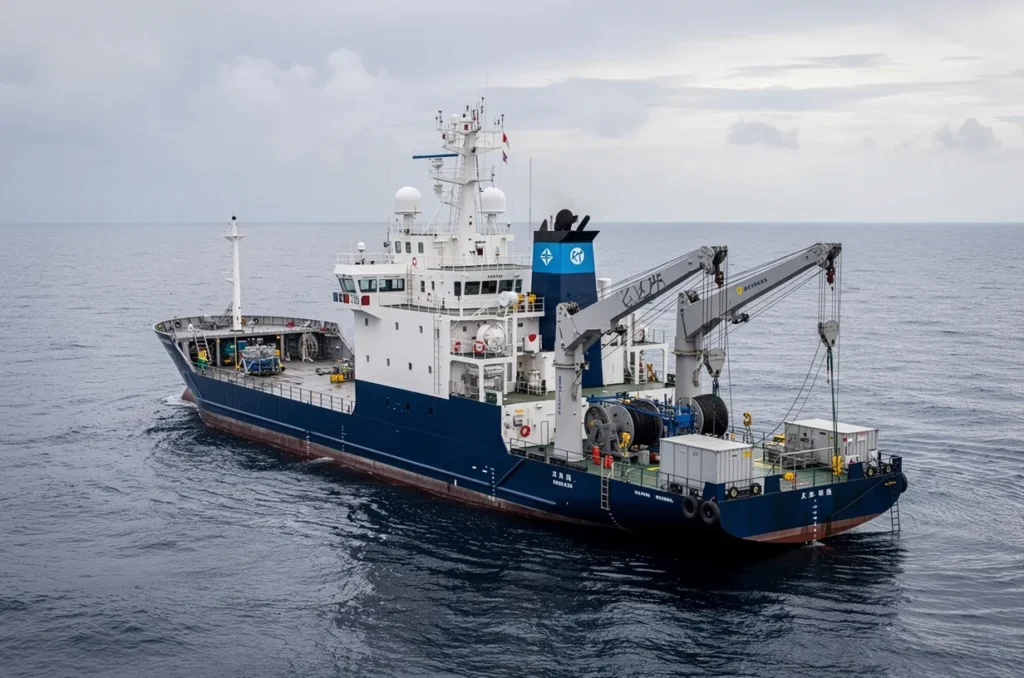
The material was collected near Minamitori Island, a remote Japanese island roughly 1,900 kilometres southeast of Tokyo. The government-backed mining vessel Chikyu recovered about 50 tonnes of mud during a month-long mission completed in February.
The expedition marked the world’s first successful continuous recovery of rare earth-bearing seabed mud from a depth of roughly 6 kilometres, according to the Japan Agency for Marine-Earth Science and Technology.
That matters because Japan is trying to prove that offshore resources can become more than a geological curiosity. The next challenge is commercial: whether the material can be recovered, processed and refined at a cost and scale that supports real supply.
Heavy rare earths are the strategic part of the deposit
The most important detail is the high share of medium and heavy rare earth elements.
Heavy rare earths are especially valuable because they are used in high-performance applications where substitution is difficult. The analysis identified several important materials, including yttrium, gadolinium and dysprosium.
Those minerals have direct industrial relevance:
- Yttrium is used in aerospace, energy and semiconductor applications
- Gadolinium is used in MRI systems and other high-tech products
- Dysprosium is used in high-performance magnets for electric vehicles
Dysprosium is particularly important because it helps permanent magnets perform under high temperatures. That makes it critical for EV motors, defence systems, robotics and advanced manufacturing.
The higher the share of heavy rare earths, the more strategically relevant the deposit becomes.
China risk is driving the urgency
Japan’s interest in seabed rare earths is not only about resource development. It is about supply-chain security.
China remains the dominant force in rare earth mining, separation, refining and magnet production. Beijing imposed export controls on some heavy rare earths and related magnets in April 2025, then tightened restrictions on shipments to Japan in January and twice more the following month.
That has made rare earth supply a more urgent issue for Japanese manufacturers. The country relies on these materials for defence equipment, electric vehicles, electronics, robotics and advanced industrial systems.
Japan does not need seabed mining to replace China overnight. It needs credible alternatives that can reduce exposure to export restrictions and give domestic industry more supply options.
The resource still needs a commercial test
Japan has not disclosed the size of the deposit or the concentration of rare earths in the recovered mud. Officials said the sampling program was too limited in duration and geography to support a broader resource estimate.
That keeps the project in the testing stage.
A full commercial assessment is expected by March 2028, and the next major step is already planned. Japan intends to launch another month-long mining trial in the same waters beginning in February 2027, targeting production of 350 tonnes of mud per day.
The material will be dewatered on Minamitori Island before being shipped to mainland Japan for separation, refining and smelting tests.
That process will determine whether the project can move from scientific achievement to industrial supply.
Japan is also mapping broader seabed mineral potential
The rare earth mud project sits within a larger push to understand Japan’s offshore mineral resources.
In 2024, researchers from the University of Tokyo and the Nippon Foundation identified more than 200 million tonnes of manganese nodules rich in battery metals in the Pacific Ocean, at depths around 5,500 metres.
A separate survey estimated those seabed nodules could contain roughly 610,000 tonnes of cobalt and 740,000 tonnes of nickel. That would represent enough cobalt for about 75 years of Japan’s consumption and enough nickel for roughly 11 years of domestic demand.
Those figures do not guarantee commercial production, but they show why Japan is investing in deep-sea resource testing. The country has limited domestic mine supply on land, but its offshore territory may contain strategic materials that are becoming harder to secure through traditional supply chains.
The opportunity is supply-chain optionality
The Japan project is still early, and deep-sea recovery faces major technical, environmental and cost questions. Operating at depths of 5.5 to 6 kilometres is difficult, and commercial rare earth production will require reliable recovery rates, processing economics and regulatory support.
The strategic value is still clear. If Japan can prove seabed mud can be recovered and processed economically, it could create a domestic source of heavy rare earths at a time when China is tightening control over exports.
That would not only support Japan’s manufacturing base. It would also give allied supply chains another potential source of materials used in EVs, defence, semiconductors and advanced technology.
WSA Take
Japan’s seabed rare earth discovery is important because the material appears rich in heavy rare earths, the part of the market most exposed to Chinese export controls. The project is not commercial yet, but the 2027 mining trial and 2028 assessment could determine whether Japan has a real domestic supply option for strategic minerals already under geopolitical pressure.
Explore More Stories in Commodities
Disclaimer
WallStAccess is a financial media platform providing market commentary and analysis for informational and educational purposes only. This content does not constitute investment advice, a recommendation, or an offer to buy or sell any securities. Readers should conduct their own research or consult a licensed financial professional before making investment decisions.