Nvidia is now investing beyond the chip
Nvidia has spent the past two years dominating the AI conversation through GPUs. Now it is making a different kind of move — one aimed at the infrastructure underneath the boom.
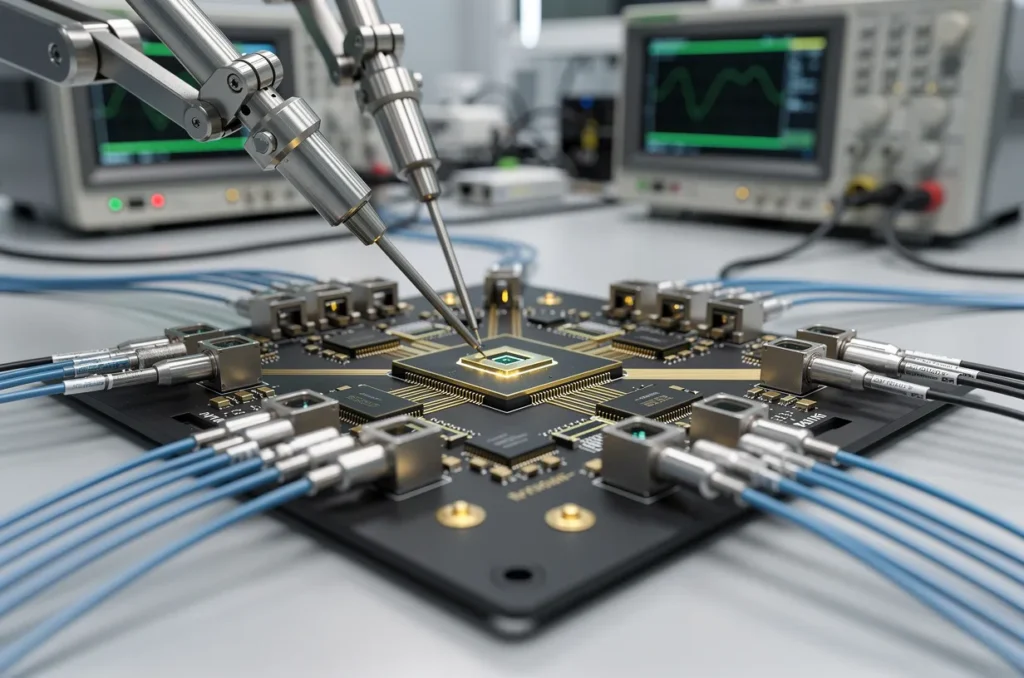
Over the last few months, the company has committed billions of dollars to firms developing photonics, a technology that uses light to transfer data. On paper, it sounds niche. In practice, it could become one of the most important pieces of the next AI buildout.
That is because the AI race is no longer just about who has the fastest chip. It is about who can move massive amounts of data across servers, racks, clusters, and data centers without hitting a wall on power, heat, and bandwidth.
Why photonics matters
Right now, much of that data still moves through electrical signals running across copper. That standard has worked for years because it has been reliable and relatively cheap.
AI is changing that equation.
As models grow larger and workloads become more intense, the amount of data moving between GPUs, memory, networking gear, and servers keeps rising. Copper starts to look less like an advantage and more like a bottleneck. It consumes more power, generates more heat, and becomes increasingly difficult to scale cleanly at the bandwidth AI systems now require.
Photonics offers a more efficient answer. Instead of pushing more electricity through copper, it uses light to move data faster and with lower energy cost.
That is why Nvidia is paying attention.
This is where the money is going
Nvidia’s spending shows it sees photonics as a real strategic layer, not a science project.
The company has announced:
- $2 billion investments in Lumentum, Coherent, and Marvell
- a $500 million investment in Corning
- participation in Ayar Labs’ $500 million Series E
Taken together, that adds up to at least $6.5 billion committed since March.
That is a meaningful number on its own. More important, it shows Nvidia is trying to secure capacity, partnerships, and supply-chain depth early, before optical connectivity becomes too important to scramble for later.
This is about scaling AI without blowing up the power bill
Nvidia’s logic is straightforward.
AI data centers are already becoming enormous power consumers. Training clusters are growing, inference workloads are expanding, and next-generation rack-scale systems are demanding more bandwidth than older electrical interconnects can handle efficiently. If the industry keeps trying to scale with the same architecture, performance gains will increasingly run into energy and infrastructure limits.
Photonics gives Nvidia a path around that problem.
Instead of just making faster compute, the company is investing in a way to make the whole system move better. That includes GPU-to-GPU links, networking platforms, and what Nvidia increasingly calls AI factories — giant compute environments built to train and run models at industrial scale.
Jensen Huang has already signaled how serious this is
Nvidia is not being quiet about the need.
At GTC in March, Jensen Huang said the amount of silicon photonics capacity Nvidia will need is already far beyond what the world currently produces. That is the kind of comment investors should pay attention to. It means the company is not simply testing a future option. It is planning around an expected shortage.
Once Nvidia starts talking publicly about needing more upstream capacity, it usually means the internal roadmap is already moving in that direction.
That is exactly what this looks like.
This is also lifting a whole new corner of the market
Wall Street has noticed.
Stocks tied to the theme have moved sharply higher. Lumentum, Coherent, Marvell, and Corning have all seen strong gains this year as investors start to recognize photonics as one of the next major picks-and-shovels layers in the AI trade.
That makes sense. When the market believes a new infrastructure bottleneck is becoming critical, it tends to revalue the suppliers that sit closest to the solution.
For investors, this is the same pattern seen earlier in power equipment, cooling, and memory. AI starts in compute, then spreads into the supporting systems that make scale possible.
Photonics looks like one of the next major beneficiaries of that process.
Nvidia is not alone, but it is moving early and with size
Other major players are already circling the same theme.
AMD has also backed Ayar Labs and has made moves into adjacent optical technologies through acquisitions and equity investments. Venture arms tied to Alphabet and Microsoft have also backed startups in the optical-connectivity space.
Still, Nvidia’s move stands out for one reason: scale.
The company is not just placing venture-style bets. It is putting real industrial money to work. That suggests it sees photonics as essential to its own future roadmap, not simply a promising area to watch.
There is still one big problem: manufacturing
None of this means the transition will happen overnight.
The hardest part is not proving the science. It is scaling production. Optical assemblies require extreme precision, and manufacturing yields can be difficult because the packaging and alignment of optical and silicon components leave very little room for error.
That is why this story is so important right now. Nvidia is not only investing in the technology. It is effectively investing ahead of the manufacturing bottleneck as well.
Most analysts still expect large-scale adoption to build gradually, with broader rollout likely later in the decade rather than immediately. That does not weaken the thesis. It strengthens the case for why Nvidia is moving now.
WSA Take
Nvidia’s photonics push is one of the clearest signs yet that the AI race is entering a new phase.
For the first phase, winning meant building the best chips. For the next phase, winning may depend just as much on moving data more efficiently across the entire system. That is where photonics comes in, and that is why Nvidia is spending billions before the rest of the market fully catches up.
This is how platform leaders stay ahead. They do not wait for the next bottleneck to become obvious. They start buying the solution early.
Disclaimer
WallStAccess is a financial media platform providing market commentary and analysis for informational and educational purposes only. This content does not constitute investment advice, a recommendation, or an offer to buy or sell any securities. Readers should conduct their own research or consult a licensed financial professional before making investment decisions.