
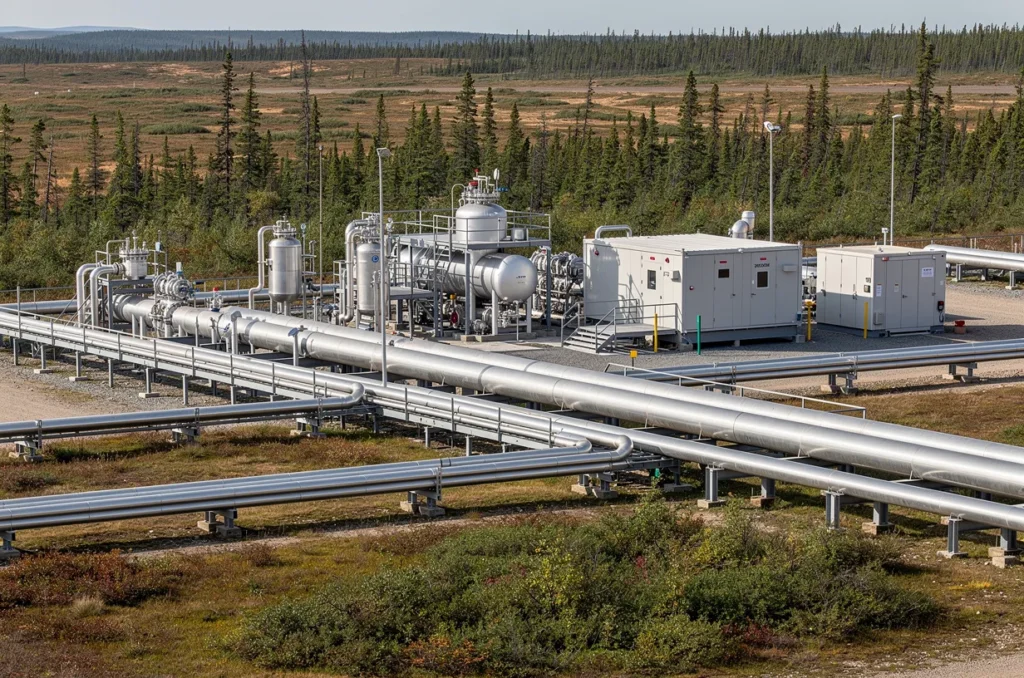
Shell is making its biggest reserve move in years
Shell Plc (NYSE: SHEL) agreed to acquire ARC Resources (TSX: ARX) for $13.6 billion, marking the company’s biggest deal in more than a decade and one of the largest Canadian oil and gas transactions in years.
The transaction gives Shell a larger position in a high-quality, low-cost shale gas and liquids base in Canada. It also signals that CEO Wael Sawan is willing to use M&A more aggressively as Shell works to strengthen its long-term resource base.
That matters because one of the louder questions around Shell in recent years has been whether it was doing enough to replace reserves while still delivering strong shareholder returns.
Canada is becoming a much more important Shell hub
The strategic logic of the deal is fairly straightforward. ARC’s operations sit in the same broader region as Shell’s existing Groundbirch asset in British Columbia, which helps supply LNG Canada, the liquefied natural gas project where Shell owns a 40% stake.
That gives the acquisition a lot more weight than just adding barrels or acreage. It tightens Shell’s grip on a region that is becoming increasingly important to its long-term gas and LNG strategy.
The deal also adds exposure to:
- LNG Canada
- ARC’s supply arrangement into Cedar LNG
- more long-life Canadian gas and liquids reserves
In practical terms, Shell is not just buying production. It is buying more control over a strategic North American LNG corridor.
The transaction fits Shell’s broader oil-and-gas reset
This deal also lines up with the broader direction Shell has taken under Sawan.
Over the past three years, management has focused on:
- repairing the balance sheet
- cutting costs
- selling lower-return assets
- and leaning harder into core oil and gas businesses
So while the headline is large, the logic is consistent. Shell is not buying ARC to diversify away from hydrocarbons. It is buying ARC to reinforce its hydrocarbon base in an area where it already has operating advantages.
That is why the company described the acquisition as a way to deliver more value while supporting lower-emissions supply relative to some other resource types.
The reserve replacement story is a big part of the appeal
One of the clearest messages in this deal is that Shell wants to lock in more durable resource depth.
The company said the transaction supports its goal of sustaining material hydrocarbon liquids production of around 1.4 million barrels per day toward 2030 and beyond. That is important because supermajors are constantly being judged on how well they can maintain production without overpaying for growth.
ARC helps on that front because it brings a large, established, low-cost resource base rather than a speculative exploration package.
For investors, that makes the acquisition easier to understand. This is a scale-and-duration deal, not a swing-for-the-fences bet.
The structure helps explain the market reaction
The deal will be paid with about 25% cash and 75% shares, at a 20% premium to ARC’s 30-day weighted average price.
That helps explain the split market reaction:
- ARC shares jumped sharply
- Shell shares dipped
That is normal for a transaction like this. The target trades up because investors are getting a takeover premium. The buyer often trades down because the market starts immediately asking whether the purchase price is right, how much dilution is involved, and how long it will take to realize the strategic and financial benefits.
That does not mean the market hates the deal. It means investors are doing the usual math on value transfer and execution risk.
This is also a notable shift in Shell’s North America posture
The acquisition stands out even more when viewed against Shell’s recent history in North America.
The company had previously sold much of its oil sands position in 2017 and exited its Permian shale assets in 2021. This ARC purchase signals a different posture: more concentrated, more selective, and more willing to build around gas and LNG where Shell sees stronger long-term strategic value.
That is an important distinction.
Shell is not simply “coming back” to North American upstream in a broad way. It appears to be building around a much more specific thesis tied to Canadian gas, LNG exports, and long-duration supply.
The LNG angle gives the deal extra weight
The LNG connection is probably what makes this transaction more compelling than a plain reserve acquisition.
Global LNG remains one of the more strategically important energy markets, and Canada is increasingly relevant because it offers export capacity tied to politically stable North American supply. By adding ARC, Shell strengthens feedstock depth around LNG Canada and gains another point of relevance through Cedar LNG.
That matters because long-life LNG-linked gas assets are generally easier to defend strategically than commodity barrels with no clear infrastructure advantage behind them.
The market may still debate valuation, but the industrial logic is clear.
What investors should watch next
The deal still needs:
- shareholder approval
- court approval
- regulatory approval
and is expected to close in the second half of 2026.
Between now and then, the key investor questions will be:
- whether Shell can prove the deal is accretive to free cash flow
- whether integration looks straightforward
- whether LNG Canada ramp-up continues cleanly
- and whether this is the start of a larger M&A push or a more targeted one-off move
Those answers will shape whether the market ultimately treats this as smart reserve consolidation or an expensive late-cycle purchase.
WSA Take
Shell’s ARC deal looks like a serious statement that the company wants more long-life gas depth and more leverage to Canadian LNG. It is big, it is strategic, and it gives Shell a stronger foothold in one of the more important gas export regions in North America.
For investors, the case is fairly simple: Shell is choosing to bulk up where it already has operating logic, infrastructure relevance, and LNG exposure. The question is not whether the assets fit. The real question is whether the price and timing prove as attractive a year from now as they do strategically today.
Explore More Stories in Commodities
Disclaimer
WallStAccess is a financial media platform providing market commentary and analysis for informational and educational purposes only. This content does not constitute investment advice, a recommendation, or an offer to buy or sell any securities. Readers should conduct their own research or consult a licensed financial professional before making investment decisions.