Washington is putting federal financing behind a large-scale nuclear buildout
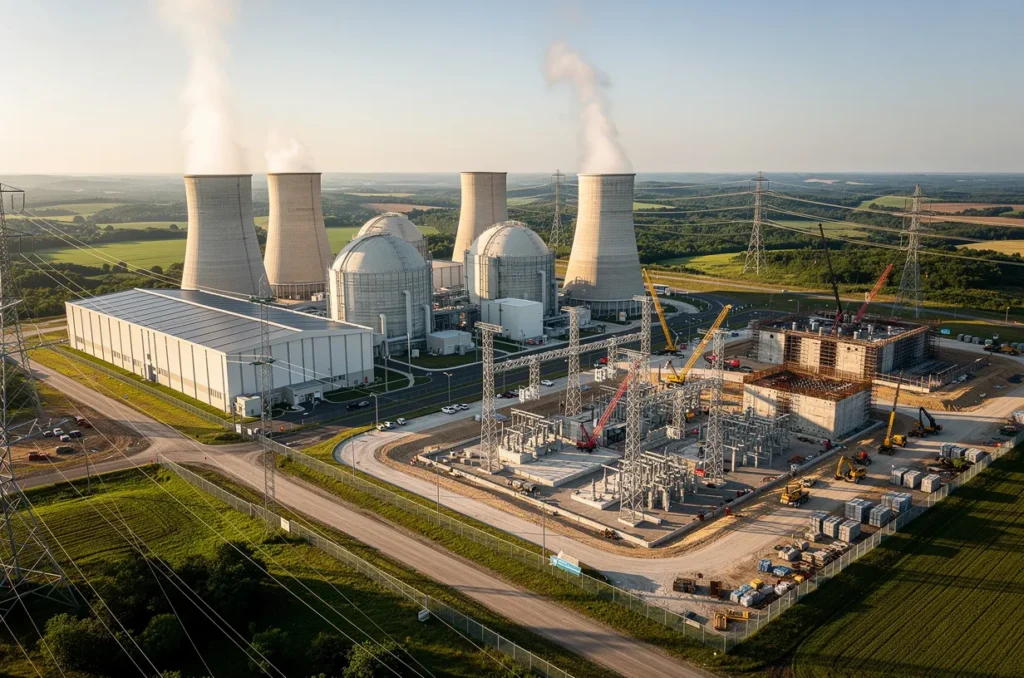
The Energy Department has conditionally committed $17.5 billion in financing to accelerate the potential construction of 10 large nuclear reactors across the United States.
The program would support five separate projects, each containing two Westinghouse AP1000 reactors. At 1.1 gigawatts per unit, the full buildout would add approximately 11 gigawatts of around-the-clock electricity generation—enough to supply roughly 8 million homes based on Energy Department estimates.
The loans are intended to address one of the earliest and most difficult barriers facing new nuclear developments: securing expensive components years before a plant begins generating revenue.
The funding targets the equipment that causes early delays
Large nuclear projects depend on specialized components that require long manufacturing timelines.
Reactor pressure vessels, steam generators and other major systems must often be ordered years before installation. Suppliers may be reluctant to expand production without firm orders, while utilities may hesitate to place those orders before financing, regulatory approvals and customer commitments are sufficiently advanced.
The federal loans are designed to break that cycle by financing long-lead equipment earlier in the development process.
Energy Secretary Chris Wright said the structure could accelerate deployment by as much as three years. That would be meaningful for an industry where delays during procurement can extend already lengthy construction schedules.
This is financing support, not approval to begin building
The announcement does not mean 10 reactors are now fully financed or ready for construction.
Final sites have not been disclosed, and the Energy Department has not selected which developers will receive the loans. Westinghouse has signed letters of intent with seven potential partners that have identified candidate locations, but the final five projects remain undecided.
The loans will also not be paid directly to Westinghouse.
Instead, financing will flow through five special-purpose vehicles created for the individual projects. Westinghouse and its development partners will be required to contribute nearly $1 billion in equity to each vehicle before accessing federal loan proceeds.
That requirement keeps substantial private capital at risk and places responsibility for project execution on the developers rather than the government alone.
The AP1000 gives the program a standardized design
All 10 reactors would use Westinghouse’s AP1000 technology.
The design is a large pressurized-water reactor capable of producing approximately 1.1 gigawatts of electricity. It uses passive safety systems and modular construction intended to reduce complexity compared with earlier generations of nuclear plants.
Two AP1000 units are already operating at Plant Vogtle in Georgia, giving developers a recent US reference project for licensing, construction and supply-chain planning.
Using one standardized design across several projects is central to the strategy. Repeating the same reactor could allow manufacturers, engineering firms and construction teams to apply lessons from one site to the next rather than treating every plant as a custom development.
Standardization alone will not eliminate cost overruns or construction risk. It could, however, make serial deployment more achievable than repeatedly introducing new designs.
AI data centres are becoming the most likely anchor customers
The renewed interest in large nuclear plants is closely tied to the rapid growth of artificial intelligence infrastructure.
Hyperscale data centres require enormous amounts of dependable electricity, and technology companies increasingly want power sources that can operate continuously without direct carbon emissions.
Microsoft and Google have already signed agreements supporting the restart of previously closed nuclear facilities. Those deals demonstrate that large technology companies are willing to make long-term commitments to existing nuclear generation when it supports their data-centre growth plans.
The next step would be signing power-purchase agreements that support the construction of entirely new large reactors.
Energy Department officials expect major technology companies to play that role. Long-term contracts from investment-grade buyers could provide the predictable revenue needed to finance projects that may take years to build and operate for several decades.
No such agreement has yet been announced for the projects covered by the new loan program.
The plan creates direct exposure for Westinghouse’s owners
Westinghouse would be the clearest industrial beneficiary if the reactor program advances.
The company is jointly owned by Brookfield and Cameco, giving both companies exposure to a potential revival in large-scale US nuclear construction. Cameco shares moved higher following the announcement.
Westinghouse would benefit from reactor technology contracts, engineering work, equipment orders and long-term service agreements. Cameco could also gain indirectly from rising nuclear fuel demand if additional reactors enter service.
A 10-unit program would create demand across a much wider supply chain, including heavy manufacturing, engineering, construction, uranium conversion, enrichment and fuel fabrication.
The economic opportunity is therefore larger than the reactor vendor alone.
The biggest challenge remains execution
The US nuclear industry has struggled for decades to complete new large reactors on predictable schedules and budgets.
Federal financing can lower borrowing costs and allow developers to order major components earlier. It does not remove the other risks attached to nuclear construction.
Each project will still require:
- a suitable and approved site
- federal and state regulatory approvals
- transmission and grid connections
- qualified construction workers
- long-term electricity customers
- billions of dollars in additional private capital
Local opposition, permitting disputes, supply-chain constraints and rising construction costs could still delay or prevent individual developments.
The $17.5 billion commitment addresses an important bottleneck, but it is only one part of the capital required to deliver 10 operating reactors.
Large reactors are returning to the energy debate
Much of the recent nuclear investment conversation has focused on small modular reactors. The Energy Department’s latest move shows that policymakers also see an important role for conventional gigawatt-scale plants.
Large reactors offer significant output from a relatively small physical footprint and can operate at high capacity around the clock. Their weakness is the enormous upfront cost and long period between initial investment and commercial operation.
Small reactors may offer more flexibility, but most designs have yet to demonstrate commercial-scale deployment in the United States. The AP1000, by contrast, has an existing licence and recent operating examples.
The federal strategy appears to be pursuing both approaches: supporting advanced and modular designs while trying to restart construction of proven large reactors.
The 2030 target remains ambitious
The White House has called for construction to begin on 10 large reactors by 2030.
Westinghouse has committed to supporting that objective, but the timeline remains demanding. Final project selections, financing agreements, site approvals and major equipment orders would all need to advance quickly.
The new loans improve the odds that developers can place early orders without carrying the entire financial burden themselves. Whether they can convert that support into construction starts will depend on utilities, technology companies, regulators and capital providers moving in parallel.
The program should therefore be viewed as a major enabling step rather than proof that all 10 reactors will be built.
WSA Take
The $17.5 billion commitment is one of the clearest signs yet that the US nuclear revival is moving from policy language toward project financing.
The structure targets a genuine obstacle: developers cannot shorten construction schedules unless they order specialized components years in advance. Federal loans can make those early commitments easier and help rebuild a domestic nuclear supply chain around a standardized reactor design.
Execution remains the decisive test. Sites have not been selected, technology companies have not yet signed power agreements for new large plants, and developers must contribute substantial equity before accessing the loans.
The financing makes 10 new AP1000 reactors more plausible. It does not make them inevitable.
Disclaimer
WallStAccess is a financial media platform providing market commentary and analysis for informational and educational purposes only. This content does not constitute investment advice, a recommendation, or an offer to buy or sell any securities. Readers should conduct their own research or consult a licensed financial professional before making investment decisions.