India’s tariff move is backfiring into the informal market
India raised gold import tariffs to 15% in May to curb demand, narrow the trade deficit, and support the rupee. Instead, the move is reopening one of the market’s oldest problems: smuggling.
The country remains the world’s second-largest gold market after China. When import duties move this sharply, demand rarely disappears. It shifts into unofficial channels.
The pricing gap is now too large for the legal market to absorb
The grey market is offering discounts that formal importers cannot match.
According to bullion dealers, the tax burden on legal gold now totals 18.45% once import duties and goods and services tax are combined. That has pushed grey-market discounts beyond $200 an ounce, or more than 4%.
Banks cannot compete with that. A formal importer struggling to offer even a single-digit discount is not going to win business against an illegal seller cutting prices by triple digits per ounce.
Smuggling could move back above 100 tons this year
That is now the industry’s central expectation.
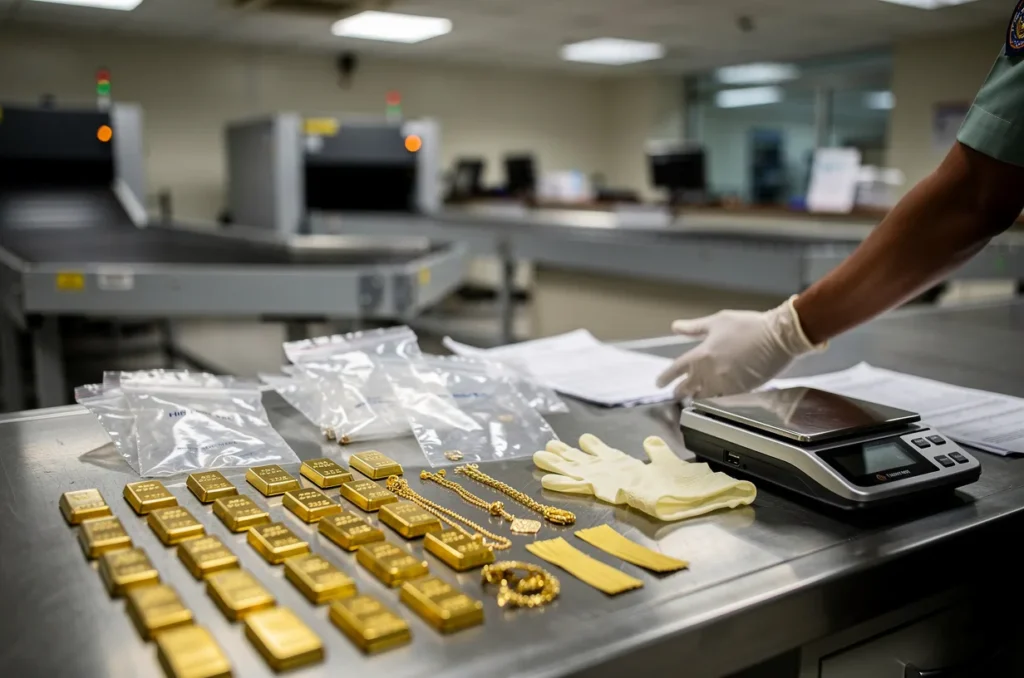
Multiple dealers cited in the source material believe illegal gold imports could exceed 100 metric tons in 2026. At current prices, that would represent about $14.35 billion worth of gold moving outside the legal channel and roughly $2.65 billion in lost tariffs and sales tax.
For a market as large as India, those are not marginal leakages. That is a meaningful distortion of the formal trade.
The profit incentive is obvious
The spread is large enough to make smuggling highly attractive again.
Dealers estimate the margin on bringing in a single one-kilo gold bar is now more than 2.5 million rupees, or roughly $26,000. Even after offering a discount to buyers, smugglers still keep a substantial profit.
That is the kind of spread that pulls supply into the grey market quickly.
The legal market is already feeling the strain
The damage is not theoretical. Banks and refiners are already adjusting.
India imported 45.6 tons of gold in April, but dealers now expect imports may have halved in May as formal buyers pulled back. When legal supply lands into a market where untaxed gold is trading at a steep discount, normal import economics stop working.
That pressure is now showing up in domestic pricing.
Refiners are getting squeezed hardest
Refining margins were never built to withstand this kind of distortion.
Domestic discounts on legal gold have widened to more than $100 an ounce as pre-tariff inventory is dumped into the market at lower prices. That has made refining uneconomic for many operators.
India charges a 0.65% lower import duty on gold dore than on refined bullion, which normally gives refiners some room to work. Right now, that difference is not enough. If refiners operate on margins around 0.65%, but market discounts are far above that, there is little reason to import dore and process it through the formal system.
This is a sharp reversal from the recent trend
The smuggling trade had been moving the other way.
Illegal gold inflows fell from 156.1 tons in 2023 to 69.2 tons in 2024, then dropped again to 20.4 tons in 2025 after India cut import duties. Before that duty reduction, annual smuggling had averaged 108 metric tons over the prior decade, according to World Gold Council data cited in the source material.
That history makes the current reversal easy to read. Lower duties pushed trade back toward official channels. Higher duties are now pushing it back out.
The policy goal is understandable. The market reaction is predictable.
New Delhi wanted to cool imports and reduce pressure on the external balance. That objective is clear enough.
Gold, however, is one of the hardest commodities to manage through tariffs alone. It is compact, high-value, easy to move, and backed by persistent demand. When the difference between legal and illegal pricing becomes wide enough, the black market gets stronger.
That is exactly what is happening now.
WSA Take
India’s gold tariff hike is not destroying demand. It is rerouting it.
The government may succeed in reducing official import volumes for a time, but the cost is a weaker legal market, rising pressure on refiners and banks, and a likely jump in smuggling. If illegal inflows do move back above 100 tons, the tariff increase will look less like a trade-control measure and more like a subsidy for the grey market.
Explore More Stories in Commodities
Disclaimer
WallStAccess is a financial media platform providing market commentary and analysis for informational and educational purposes only. This content does not constitute investment advice, a recommendation, or an offer to buy or sell any securities. Readers should conduct their own research or consult a licensed financial professional before making investment decisions.