Anduril is taking on a very different kind of defense problem
Anduril built its reputation on autonomous drones, sensors and software. Its newest target weighs nearly 8,000 tons and takes years to build.
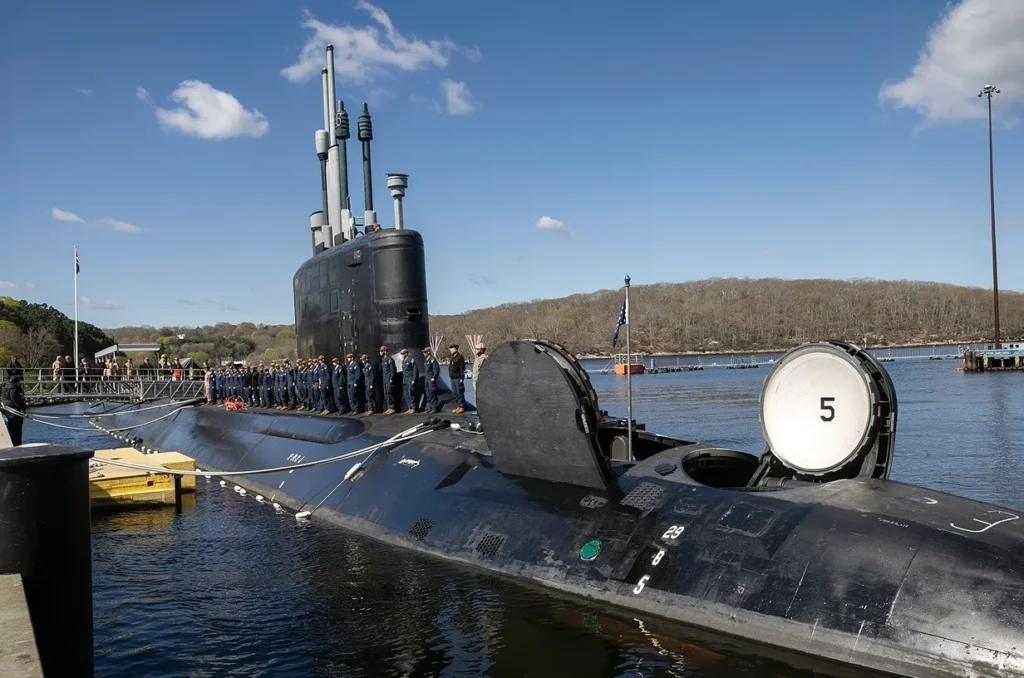
The company has landed an up to $2.9 billion U.S. Navy contract to enter the Virginia-class submarine supply chain, manufacturing components and eventually much larger sections of the nuclear-powered attack submarine.
Supporting that push will be Arsenal-2, a massive new manufacturing complex at Sparrows Point outside Baltimore. The project combines $3.7 billion of Anduril capital with up to $2.9 billion from the Navy, creating a roughly $6.6 billion industrial expansion built around one of America’s most important weapons programs.
Operations are expected to begin in 2030, with the 2 million-square-foot facility supporting approximately 3,100 permanent jobs. Torpedo tubes and other components will also be produced at an existing Anduril facility in California.
For Anduril, this is a major departure from the relatively compact weapons and autonomous systems that made the company famous. The startup now wants to prove that the same software-driven manufacturing philosophy can work inside one of the slowest, most complex corners of the defense industry.
That could be far more consequential than another drone contract.
America has a submarine production problem
Demand for Virginia-class submarines is not the issue. Building enough of them is.
General Dynamics (NYSE: GD) Electric Boat and Huntington Ingalls Industries (NYSE: HII) remain the lead shipbuilders, but years of workforce shortages, supplier constraints and production delays have created a growing backlog.
Despite a procurement target of two Virginia-class submarines per year, actual production has been running at only about 1.2 to 1.4 boats annually. The Navy wants that rate back to two per year and eventually around 2.33 submarines annually, partly to support commitments under the AUKUS agreement with Australia.
Building faster requires more than asking the existing shipyards to work harder. The Navy needs additional suppliers capable of taking entire blocks of work away from the primary yards so they can concentrate on final assembly, integration and testing.
Anduril is stepping directly into that gap.
Early production will focus on individual components, but management has already made clear that the ambition extends much further. Over time, Anduril wants Arsenal-2 producing large sections of Virginia-class submarines, effectively becoming another major manufacturing node inside the submarine industrial base.
The opportunity is not to replace America’s existing shipbuilders. It is to remove the bottlenecks preventing them from building faster.
America is pouring capital into a new generation of defense technology and manufacturing. See the companies and themes Wall Street Access is following →
Defense tech is moving from software into heavy industry
Silicon Valley’s first disruption of defense centered on software, autonomy and cheaper weapons.
Palmer Luckey’s Anduril, SpaceX and a growing group of venture-backed contractors argued that Pentagon procurement had become too slow and too concentrated among traditional primes. Their answer was faster development cycles, privately funded R&D and manufacturing designed more like a technology company than a conventional defense contractor.
Submarines represent a much harder test of that philosophy.
Welding enormous sections of nuclear-powered vessels, maintaining extremely tight tolerances and meeting Navy quality standards bear little resemblance to assembling drones. Success requires skilled labor, heavy equipment, complicated supply chains and years of disciplined execution.
Anduril nevertheless sees room to rethink how those factories operate. Automation, digital design and software-driven production will sit at the center of Arsenal-2, giving the company a chance to build the facility around modern manufacturing practices rather than retrofit a shipyard designed decades ago.
If it works, Anduril could demonstrate that defense-tech companies can compete for something much larger than the next generation of weapons. They can compete for the factories that build them.
Washington is giving defense-tech companies a bigger seat at the table
Anduril’s expansion arrives as technology executives gain a growing role in shaping future Pentagon priorities.
Days before the submarine announcement, Luckey was named a co-director of Project Meridian alongside SpaceX CEO Elon Musk and former House Speaker Newt Gingrich. The Pentagon-backed initiative will examine the technologies and operational concepts the U.S. may need in future conflicts. Project Meridian brings together technology, defense and policy leaders to recommend future military capabilities.
The timing will inevitably attract scrutiny because Anduril continues competing for billions of dollars in government business. Pentagon officials have argued that industry participation is exactly the point: future weapons planning increasingly requires expertise from companies developing AI, autonomous systems, advanced manufacturing and space technology.
Either way, a broader shift is becoming difficult to miss.
Anduril is no longer a defense startup trying to convince Washington that autonomous weapons matter. It is winning multibillion-dollar programs, building enormous factories and entering supply chains once dominated almost entirely by legacy contractors.
Submarine manufacturing may be the clearest sign yet of how far that transition has gone.
America’s defense-tech boom started with software and drones. Its next chapter could be about rebuilding the industrial base itself.
Disclaimer
Wall Street Access is an independent financial publisher. Wall Street Access is not a financial advisor. No company mentioned has compensated Wall Street Access for the preparation, publication or distribution of this article. This content is provided for informational and educational purposes only and is not investment advice or a recommendation to buy, sell or hold any security. Investing involves risk, including the possible loss of principal.
Prices, market capitalizations, financial figures and other market data are based on information available as of the date and time of publication and may change without notice. Information is drawn from public sources believed to be reliable but is not guaranteed to be complete or accurate. Opinions and expectations expressed are our own and may change as new information becomes available.
Readers should conduct their own due diligence and contact a licensed financial professional before making any investment decision. Past performance does not guarantee future results. Any material ownership interest or conflict of interest, where applicable, will be disclosed separately.