Europe is spending billions on weapons. But where will the materials come from?
Germany is preparing one of the largest military spending increases in its modern history.
Under the government’s 2027 draft budget, core defense spending would jump from €82.2 billion in 2026 to €109 billion in 2027, with total security-related spending reaching approximately €130 billion when support for Ukraine and other commitments are included.
Across Europe, the buildup is even larger. NATO members have committed to spending 5% of GDP on defense and related security requirements by 2035, creating a multiyear investment cycle in ammunition, missile systems, military vehicles and advanced manufacturing.
European governments are finding the money. Defense contractors are expanding factories and increasing production.
But one critical problem remains largely unresolved.
Europe does not mine the antimony needed for some of the weapons and military technologies it increasingly wants to produce.
The European Commission’s own research confirms that the EU has no reported domestic antimony extraction and relies entirely on imports of antimony ore.

For a region spending hundreds of billions to strengthen its military independence, that is a remarkable supply-chain vulnerability.
And it may create an overlooked opportunity for companies exploring the few remaining antimony deposits within European borders.
Antimony is a small metal with an enormous strategic role
Antimony rarely receives the attention given to copper, lithium or rare earth elements. Yet its properties make it difficult to replace in several important industrial and defense applications.
The metal is used in:
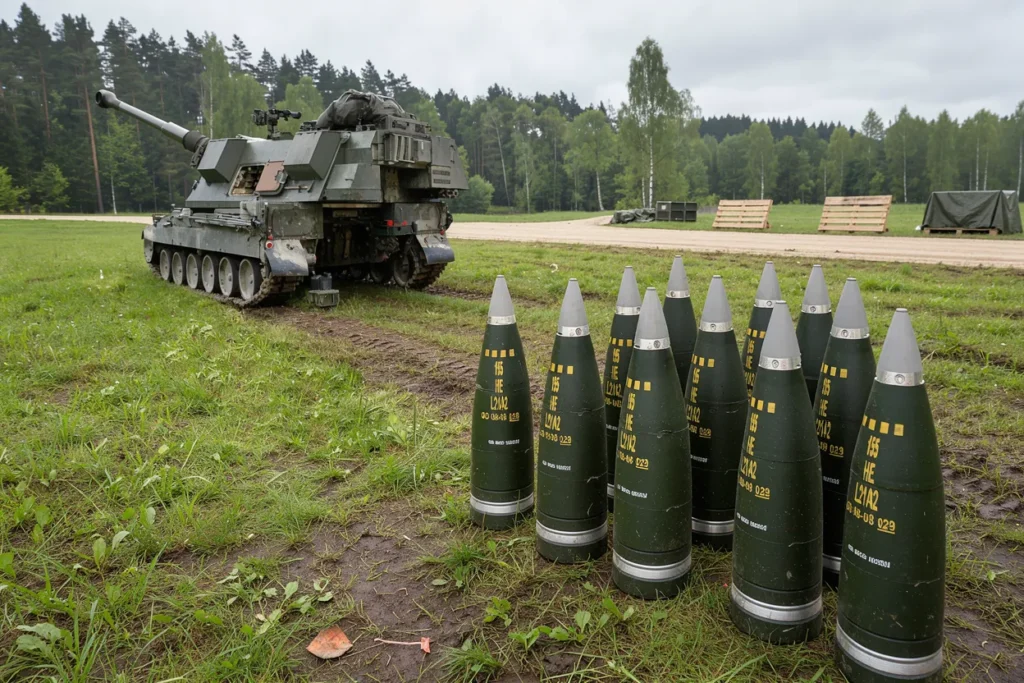
- Ammunition and military equipment: Antimony hardens lead alloys used in projectiles and is used in certain ammunition, explosives and ignition systems
- Advanced defense technology: Antimony compounds have applications in infrared sensors, night-vision systems and specialized military optics
- Fire protection: Antimony trioxide helps improve flame resistance in plastics, electronics, textiles and other manufactured products
- Batteries and electronics: Antimony is used in lead-acid battery alloys, semiconductors and specialized electronic materials
The strategic concern goes well beyond total consumption.
According to S&P Global’s August 2026 antimony market report, Chinese- and Russian-controlled operations account for approximately 80% of global antimony mine supply and 81% of processing capacity.
China also introduced export licensing requirements for antimony and related products in 2024, demonstrating how quickly access to critical materials can become a geopolitical issue.
Europe sources antimony through several trading partners and maintains some downstream processing capacity. What it lacks is a meaningful domestic source of newly mined antimony.
That matters as European defense manufacturers try to build more resilient supply chains. Even where antimony represents a small portion of a finished product’s cost, an unavailable specialized input can complicate production.
Increasing military budgets is one challenge. Securing the raw materials needed to turn those budgets into equipment is another.
For mining investors, the distinction is worth examining. An antimony deposit located within the European Union could eventually have strategic relevance beyond the ordinary economics of a commodity project.
A potentially important antimony resource sits just outside Bratislava
Approximately 20 kilometres northeast of Slovakia’s capital, Bratislava, lies the Trojárová antimony-gold project.
The property is controlled by Military Metals Corp. (CSE: MILI | OTCQB: MILIF | FSE: QN90), an exploration company focused on helping supply Europe’s antimony production.
Trojárová is particularly interesting because the company has already moved beyond relying exclusively on historical estimates.
In April 2026, Military Metals, announced its first modern NI 43-101 mineral resource estimate, prepared independently by SLR Consulting.
The estimate outlined:
- 6.5 million tonnes of inferred mineral resources
- 1.02% antimony average grade
- 1.06 grams per tonne gold average grade
- Approximately 67,000 tonnes of contained antimony
- Approximately 222,000 ounces of contained gold
The resource incorporates 53 diamond drill holes totaling 7,167 metres, along with historical underground sampling and more recent confirmation work.
These are inferred mineral resources, not proven reserves or immediately recoverable metal. Further engineering, economic and environmental studies would be required before production could be considered.
Nevertheless, the figures establish a technically documented antimony-gold deposit in a region where the EU currently reports no domestic antimony extraction.
That combination of location, mineral endowment and growing strategic demand is what makes Trojárová worth following.
Gold provides an additional dimension to the project, although its eventual economic contribution remains subject to further evaluation.
Europe’s critical mineral supply chains are attracting renewed attention. Stay connected with Wall Street Access as we follow emerging opportunities in strategic metals and defense-related resources

The project was taken away. Now it has a second chance.
Trojárová’s potential was not enough to protect Military Metals Corp. (CSE: MILI | OTCQB: MILIF | FSE: QN90) from a major regulatory setback earlier this year.
On May 28, 2026, Slovakia’s Ministry of the Environment unexpectedly cancelled the project’s exploration licence following an unscheduled review.
The announcement created substantial uncertainty for the company. Its shares came under pressure as investors questioned whether Military Metals would retain the rights needed to advance its flagship European asset.
Management challenged the cancellation and formally appealed in June, arguing that the decision lacked sufficient justification.
Months later, the situation reversed.
On October 2, the ministry annulled the earlier cancellation, restoring the exploration licence. A subsequent decision extended the permit for another four years, through October 18, 2030.
Military Metals confirmed the reinstatement and extension on October 19, eliminating a major regulatory uncertainty that had overshadowed the project for months.
Investors responded quickly.
Military Metals (CSE: MILI | OTCQB: MILIF | FSE: QN90) shares surged approximately 28% on Monday, reaching C$0.255, as attention returned to the project’s antimony resource and future development potential.
The reversal is significant because the underlying mineral resource had not disappeared during the licensing dispute. The uncertainty centered on the company’s ability to continue working toward its development.
With exploration rights restored through 2030, Military Metals can resume advancing a project that may eventually contribute to Europe’s domestic antimony supply.
The stock’s price history still reflects substantial volatility, and Monday’s rebound does not erase the risks involved. But the decision restores a pathway that had been thrown into doubt.
Why the next phase could attract attention
A four-year exploration extension is not authorization to build a mine.
Military Metals must still demonstrate that Trojárová can be developed economically, advance environmental studies and secure separate mining and production approvals.
Management has begun discussions with Slovak authorities regarding those requirements. The company also plans stronger local community engagement, cooperation with the Technical University of Košice and work involving wastewater management and responsible mineral processing.
Those steps are important, especially for a mining project seeking approval in the European Union.
From an investment perspective, the opportunity depends on whether a defined antimony resource can progress toward a permitted, financeable European supply source.
Several developments deserve attention over the coming months: further technical work, progress on environmental approvals, potential strategic partnerships and discussions with European institutions or industrial buyers.
None of those outcomes is guaranteed. Military Metals has not announced a mine construction decision, a commercial offtake agreement or secured government financing for Trojárová.
But the broader environment is changing.
Germany is preparing a substantial defense expansion. NATO countries are committing more capital to military production. The EU is actively working to reduce critical mineral dependencies, while global antimony supply remains heavily concentrated outside Western Europe.
Projects capable of supplying critical materials from within the European Union could become increasingly interesting as those priorities translate into industrial investment.
Military Metals now has a four-year window to advance Trojárová and demonstrate how its resource could fit into that evolving supply chain.
For the company, progress on permitting, metallurgy and development planning could meaningfully influence how investors value its flagship asset.
Europe is preparing to spend billions building weapons and strengthening its defense industry, yet it still has no reported antimony mine production within the EU.

A company controlling a defined antimony resource in Slovakia has just regained the right to advance that project.
Whether Trojárová eventually becomes a producing mine remains an open question. But with a modern resource estimate, a restored exploration licence and a growing European focus on supply security,
Military Metals Corp. (CSE: MILI | OTCQB: MILIF | FSE: QN90) is a company we believe deserves a place on our critical minerals watchlist.
Subscribe to Wall Street Access
Disclaimer
Wall Street Access is an independent financial publisher and is not a registered investment advisor or financial advisor. Wall Street Access has not received any compensation from Military Metals Inc. or any third party for the preparation, publication or distribution of this article. Neither Wall Street Access nor the author owns shares of Military Metals Inc. This article is independent editorial content provided solely for informational and educational purposes and does not constitute investment advice or a recommendation to buy, sell or hold any security.
Information has been obtained from publicly available sources believed to be reliable but is not guaranteed to be accurate, complete or current. Market prices, company valuations, mineral resource estimates and other figures may change without notice. Any opinions, projections or forward-looking statements reflect current expectations and are subject to uncertainty.
Military Metals is an exploration-stage company, and investing in junior mining stocks carries significant risk. Mineral resources are not mineral reserves, and exploration permits do not guarantee future production. Project development remains subject to financing, technical studies, regulatory approvals and other uncertainties.
Readers should conduct their own due diligence and consult a licensed financial professional before making investment decisions. Past performance does not guarantee future results, and investors may lose some or all of their invested capital.