
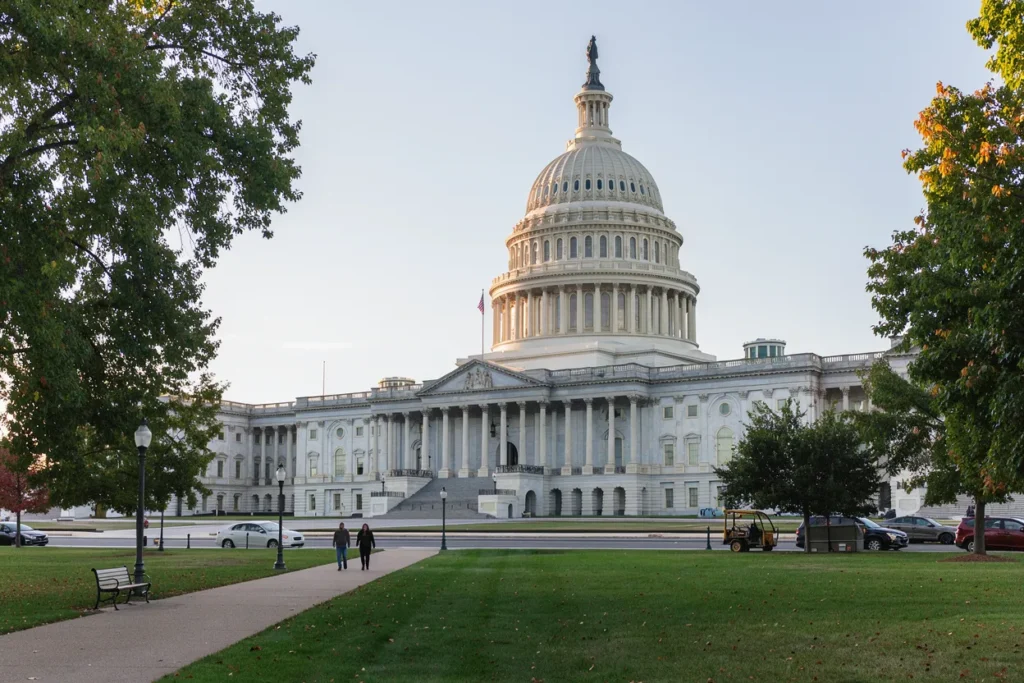
Defense spending promises still need congressional funding
Tuesday’s election could change the terms on which some of America’s largest companies collect government revenue, secure approvals and finance expansion. The investment consequences will depend on individual contracts and costs.
Lockheed Martin (LMT) provides a concrete example. Its new F-35 framework covers 850 U.S. aircraft over ten years, alongside spares, modifications and sustainment. But the company says a formal contract requires multiyear authority and associated appropriations before pricing and schedules are finalized.
Pentagon support supplies a powerful demand signal. Congress still controls essential steps toward turning that framework into funded orders.
A change in congressional control could affect negotiations over weapons programs and military spending. The relevant exposure therefore sits inside each contractor’s program mix, rather than a blanket assumption that the entire defense sector benefits or suffers.
Medicaid protection would support revenue before it fixes margins
For Molina Healthcare (MOH), Washington’s influence is already visible in its financial statements. Medicaid generated $32.2 billion, approximately 75% of premium revenue, in 2025.
The 2025 reconciliation law is projected to reduce federal Medicaid spending by $911 billion over 2025–2034, based on Congressional Budget Office estimates. New work requirements are scheduled to begin January 1, 2027, or earlier in some states.
Democratic gains could strengthen efforts to negotiate funding changes or implementation delays. An election result would not itself alter existing requirements, and control of one chamber would not provide the power to repeal the law.
Preserving enrollment could support insurers’ premium revenue and reduce hospitals’ exposure to uninsured patients. Profitability would still depend on reimbursement rates and medical costs. Molina’s Medicaid medical care ratio rose to 91.8% in 2025 from 90.3%, showing how claims expenses can absorb more revenue.
Get Our Post-Election Stock Watchlist in Your Inbox
Crypto needs rules that outlast an administration
For Coinbase (COIN) and other digital-asset businesses, the legislative question is how much regulatory certainty Congress can deliver.
The Senate failed to advance the CLARITY Act in September, leaving the proposed federal market-structure framework unfinished.
A new congressional balance could change both the likelihood of passage and the safeguards required to secure votes. Negotiations may influence compliance costs, permitted activities and consumer protections.
Clearer law can improve business planning while imposing additional obligations. The commercial value depends on the final provisions, not simply whether lawmakers describe a bill as supportive of crypto.
AI politics is becoming an argument over who pays
The data-center debate already crosses party lines. In September, the House passed the Ratepayer Protection Act by 417–3.
The proposal would require state utility commissions to consider standards making large data centers cover incremental electricity infrastructure costs. It preserves state authority and does not itself impose a universal federal charge.
For Amazon, Microsoft, Alphabet and Meta, greater responsibility for grid upgrades could raise project costs even if AI demand remains strong. Morgan Stanley’s analysis anticipates a buildout increasingly conditioned on local infrastructure and community agreements across both Republican and Democratic states.
Congressional control will influence that debate, but utility regulators and local authorities retain important decisions. For a particular AI project, the document that changes its economics could be a state utility order issued long after the congressional races are called.
Explore More Stories in Markets
Disclaimer
Wall Street Access is an independent financial publisher. Wall Street Access is not a financial advisor. No company mentioned has compensated Wall Street Access for the preparation, publication or distribution of this article. This content is provided for informational and educational purposes only and is not investment advice or a recommendation to buy, sell or hold any security. Investing involves risk, including the possible loss of principal.
Prices, market capitalizations, financial figures and other market data are based on information available as of the date and time of publication and may change without notice. Information is drawn from public sources believed to be reliable but is not guaranteed to be complete or accurate. Opinions and expectations expressed are our own and may change as new information becomes available.
Readers should conduct their own due diligence and contact a licensed financial professional before making any investment decision. Past performance does not guarantee future results. Any material ownership interest or conflict of interest, where applicable, will be disclosed separately.