The index decline was only part of the morning
The Nasdaq was sinking Tuesday morning, but a glance at retail stocks told a different story.
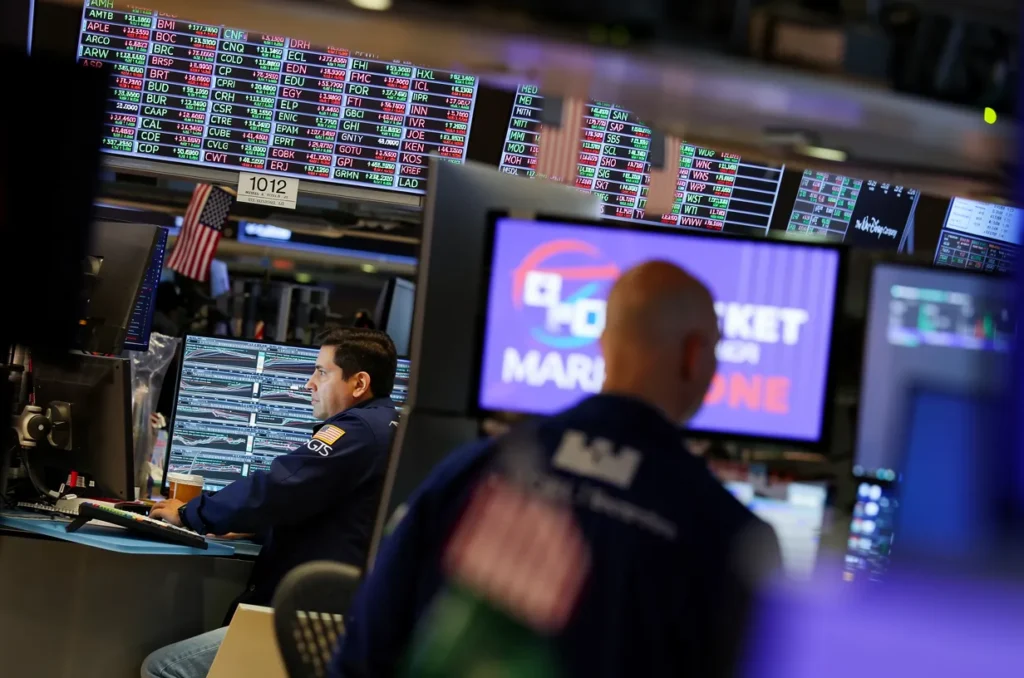
The Nasdaq is down 1.6% as chip stocks gave back part of Monday’s rally. The S&P 500 fell 0.54%, while the Dow Jones Industrial Average edged up 0.72%
That split matters after a week when Nvidia’s leadership drama dominated almost every discussion about the market.
The S&P 500 weights companies by their publicly traded market value. Large technology companies can therefore pull the benchmark lower even when more constituents rise than fall.
Tuesday’s trading showed that distinction in practice. The AI rebound was losing momentum, while companies reporting encouraging business results were still finding buyers.
Nvidia led the chip sector lower after Monday’s 31.5% surge on Jensen Huang’s reinstatement. His return settled the immediate leadership question, but it did little to change the financing costs or eventual returns attached to the industry’s enormous infrastructure commitments.
Elsewhere, the conversation was more straightforward: were customers showing up, and what were they buying?
Retailers supplied evidence beyond the AI debate
Dollar Tree (NASDAQ: DLTR) rose more than 11% in morning trading after raising its full-year outlook.
Its comparable sales increased 4.6%, including a 3.8% rise in customer traffic. Average spending per visit increased just 0.8%.
That breakdown gives the sales growth substance. More visits contributed far more than larger purchases, supporting the appeal of its value-focused stores. It does not establish that households are spending freely across the economy.
Dick’s Sporting Goods (NYSE: DKS) climbed about 15% after increasing its annual profit forecast.
Its namesake business delivered 2.6% comparable sales growth, while Foot Locker recorded 0.5% pro forma comparable growth. Those measures are more useful for judging customer demand than consolidated revenue alone, which also reflects a longer period of Foot Locker ownership.
Best Buy (NYSE: BBY) added another encouraging result. Its 6.1% comparable sales increase was its strongest in five years. Management raised its full-year comparable-sales forecast to 3.4%–4.0%.
Discount shopping, sporting goods and electronics serve different customer needs. Together, the reports show pockets of demand that a red technology index can obscure. They also leave the holiday quarter with higher expectations to meet.
The Holiday Shopping Test Comes Next. Follow the Stock Stories With WSA.
Interest rates still reach every part of the market
The earnings gains do not remove the pressure from monetary policy.
Tuesday morning’s rate-market pricing assigned a 95% probability to a quarter-point December increase, with the remaining 5% on a half-point move. Those probabilities are market estimates and can change quickly.
Higher borrowing costs complicate funding for AI infrastructure. For retailers, they can also weigh on customers financing larger purchases. Strong quarterly results and a difficult interest-rate backdrop can coexist.
The next reading arrives Wednesday, November 25, at 8:30 a.m. ET, with October’s PCE inflation report. September’s annual inflation rate was 3.6%, or 3.1% excluding food and energy.
Tuesday’s retail gains show that the market still responds to improving operations outside AI. Whether that support broadens will depend on companies delivering through the holiday season—and on inflation allowing borrowing costs to stop moving against them.
Explore More Stories in Markets
Disclaimer
Wall Street Access is an independent financial publisher. Wall Street Access is not a financial advisor. No company mentioned has compensated Wall Street Access for the preparation, publication or distribution of this article. This content is provided for informational and educational purposes only and is not investment advice or a recommendation to buy, sell or hold any security. Investing involves risk, including the possible loss of principal.
Prices, market capitalizations, financial figures and other market data are based on information available as of the date and time of publication and may change without notice. Information is drawn from public sources believed to be reliable but is not guaranteed to be complete or accurate. Opinions and expectations expressed are our own and may change as new information becomes available.
Readers should conduct their own due diligence and contact a licensed financial professional before making any investment decision. Past performance does not guarantee future results. Any material ownership interest or conflict of interest, where applicable, will be disclosed separately.