The Deal: Cybersecurity Meets Cloud AI at Scale
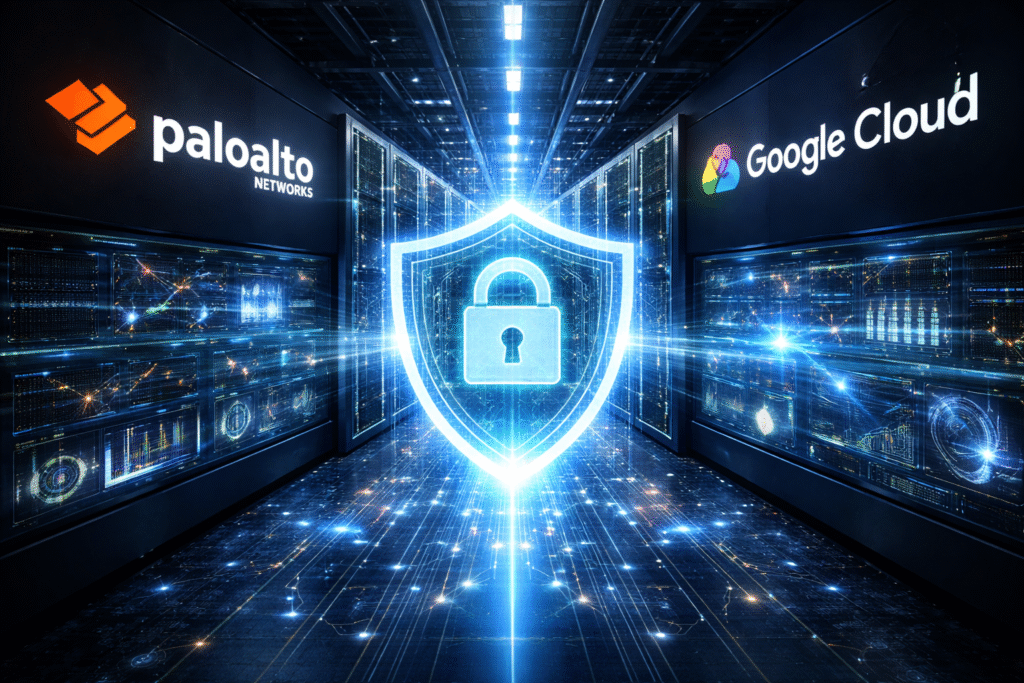
Palo Alto Networks (PANW) announced Friday that it will migrate key internal workloads to Google Cloud, significantly expanding its strategic partnership with Alphabet’s cloud division in a multibillion-dollar agreement.
The move deepens an already close collaboration between the two companies and reflects a broader industry shift: as artificial intelligence becomes embedded across enterprise systems, security is no longer an add-on — it’s core infrastructure.
Under the expanded partnership:
- Palo Alto Networks will move critical workloads to Google Cloud
- Google’s Gemini AI models will power Palo Alto’s security copilots
- Palo Alto will use Google Cloud’s Vertex AI platform to build and scale AI-driven security tools
The companies described the deal as a major step forward in engineering collaboration and AI-native security.
Why This Matters: AI Is Forcing a Rethink of Security
Enterprise adoption of AI has created a new problem for boards and CIOs: how to harness AI without exposing sensitive data, models, and infrastructure to new attack vectors.
Palo Alto Networks President BJ Jenkins framed the deal in those terms, noting that leadership teams are increasingly focused on AI risk, not just AI opportunity.
That concern is driving demand for security platforms that can:
- Protect live AI workloads and training data
- Enforce consistent security policies across cloud environments
- Secure AI agents and copilots from day one
This partnership positions Palo Alto and Google Cloud to jointly target that demand.
A Partnership That’s Already Paying Off
This isn’t a new relationship — it’s a scaled-up one.
Palo Alto Networks already has:
- 75+ joint integrations with Google Cloud
- Over $2 billion in cumulative sales through the Google Cloud Marketplace
The expanded deal allows Palo Alto customers to more easily secure AI workloads running on Google Cloud while simplifying security operations across hybrid and multi-cloud environments.
For Google Cloud, the partnership strengthens its pitch to enterprises that want AI innovation with security built in, rather than layered on afterward.
Market Reaction and Competitive Context
Shares of Palo Alto Networks rose modestly following the announcement, while Google shares were largely unchanged — a typical reaction for long-term infrastructure partnerships rather than near-term revenue shocks.
Strategically, the deal underscores two powerful trends:
- Cybersecurity is becoming AI-native, not rule-based
- Cloud providers are aligning tightly with security leaders to win enterprise AI workloads
As companies race to deploy AI agents, copilots, and autonomous systems, security vendors that integrate deeply with hyperscale clouds stand to benefit disproportionately.
WSA Take
This deal isn’t about headlines — it’s about positioning. Palo Alto Networks is embedding itself directly into the AI stack at the cloud level, where future security spending will be decided. For investors, the signal is clear: AI adoption doesn’t reduce cybersecurity demand — it amplifies it. Companies that secure AI infrastructure at scale are becoming as essential as the AI models themselves.
Read our recent coverage on Trump Media’s Surprise Merger With Fusion Power Firm TAE
Explore more market insights on the WallStreetAccess homepage.
Disclaimer
WallStAccess does not work with or receive compensation from any companies mentioned. This content is for informational and educational purposes only and should not be considered financial advice. Always conduct independent research before investing.