This is no longer the same U.S.-China fight
For years, Washington’s strategy toward Beijing relied on a fairly simple idea: the U.S. could make China’s access to important markets and technologies more difficult, especially if its allies moved with it.
That strategy still carries weight. American and allied companies control critical parts of the advanced semiconductor ecosystem, the U.S. remains at the center of global finance, and its military alliance network is far deeper than anything China has assembled.
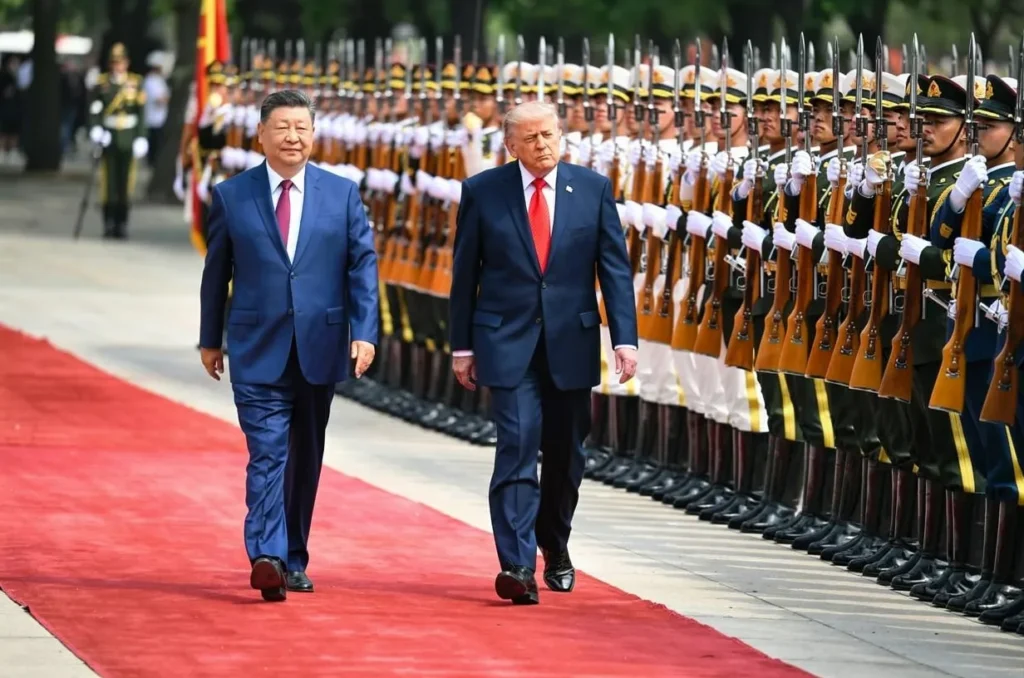
But China arrives at this week’s Washington summit in a stronger position than simply being on the receiving end of American pressure.
Its trade surplus reached a record $1.2 trillion in 2025, even as exports to the U.S. fell, showing how successfully Chinese companies have expanded into other markets. Beijing has also built pressure points in areas where Western economies have become dependent on Chinese production.
The relationship has shifted from Washington looking for ways to pressure China to both countries identifying what the other side cannot easily replace.
America’s allies are becoming part of the equation
One of Washington’s greatest advantages has always been its ability to multiply its own power through allies.
Technology restrictions become more effective when Japan, South Korea and European countries cooperate. Sanctions carry more weight when major economies move together. China does not need those countries to abandon the U.S. to weaken that advantage. A little more reluctance is enough.
Public opinion offers one indication of the changing backdrop. Pew Research found that the share of Canadians describing the U.S. as a reliable partner fell from 83% in 2022 to 35% in 2026. In Germany, the share saying Washington takes other countries’ interests into account when making foreign policy dropped from 60% in 2023 to 23% this year.
That does not mean Canada or Germany are shifting into China’s camp. It means governments have more incentive to keep multiple relationships open rather than automatically following Washington.
Recent moves illustrate the point. Canada is pursuing deeper ties with Europe, while India has worked to stabilize its relationship with China despite remaining a U.S. security partner and strategic competitor of Beijing.
The contest is increasingly about how much room countries believe they have to work with both sides.
Trade is only one part of this summit
The current trade truce expires on November 10, making tariffs and market access immediate negotiating points. Rare earth export licenses are also part of the discussion after China demonstrated how quickly restrictions on critical materials could disrupt Western manufacturers.
But the agenda stretches much further.
Key pressure points include:
- Advanced semiconductors and AI: The U.S. retains leverage over access to leading chips and manufacturing technology, while both countries increasingly view AI leadership as strategic.
- Critical minerals: China’s dominance in rare earth processing gives Beijing an important bargaining tool, although Washington is investing heavily to reduce that dependence.
- Taiwan: A proposed $14 billion U.S. arms package has become part of the broader relationship as Beijing continues to press Washington over military support for the island.
- Iran: China maintains economic and diplomatic ties with Tehran that Washington does not, raising questions about whether Beijing can play a meaningful role in any eventual diplomatic solution.
U.S. officials have also been reassuring Japan and South Korea of Washington’s defense commitments ahead of the summit, a sign that the alliance question remains intertwined with the China relationship.
The market should watch what gets traded for what
A major breakthrough is not required for the summit to affect markets.
An extension of the trade truce could reduce near-term uncertainty. Changes to semiconductor access could move AI and chip stocks. Progress on rare earth licensing could matter to autos, industrials and defense manufacturers. Any movement around Taiwan or Iran would carry a very different set of geopolitical implications.
The larger story is how the balance of leverage has evolved.
The U.S. still possesses enormous technological, military and financial advantages. China has responded by diversifying trade, strengthening its own supply chains and turning control over several critical inputs into negotiating leverage.
Neither side can easily isolate the other anymore.
This week’s summit is therefore less about one tariff rate or one export license than about how two deeply connected economic powers manage an increasingly competitive relationship, and how much support each can still draw from the rest of the world.
Explore More Stories in Markets
Disclaimer
Wall Street Access is an independent financial publisher. Wall Street Access is not a financial advisor. No company mentioned has compensated Wall Street Access for the preparation, publication or distribution of this article. This content is provided for informational and educational purposes only and is not investment advice or a recommendation to buy, sell or hold any security. Investing involves risk, including the possible loss of principal.
Prices, market capitalizations, financial figures and other market data are based on information available as of the date and time of publication and may change without notice. Information is drawn from public sources believed to be reliable but is not guaranteed to be complete or accurate. Opinions and expectations expressed are our own and may change as new information becomes available.
Readers should conduct their own due diligence and contact a licensed financial professional before making any investment decision. Past performance does not guarantee future results. Any material ownership interest or conflict of interest, where applicable, will be disclosed separately.