The AI trade stumbled again
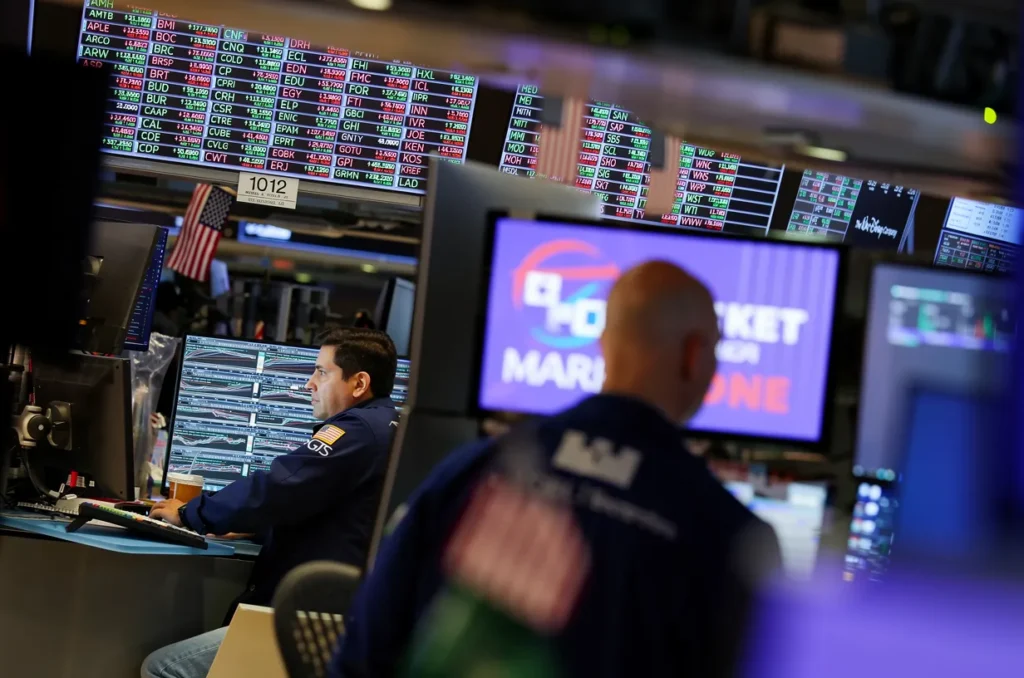
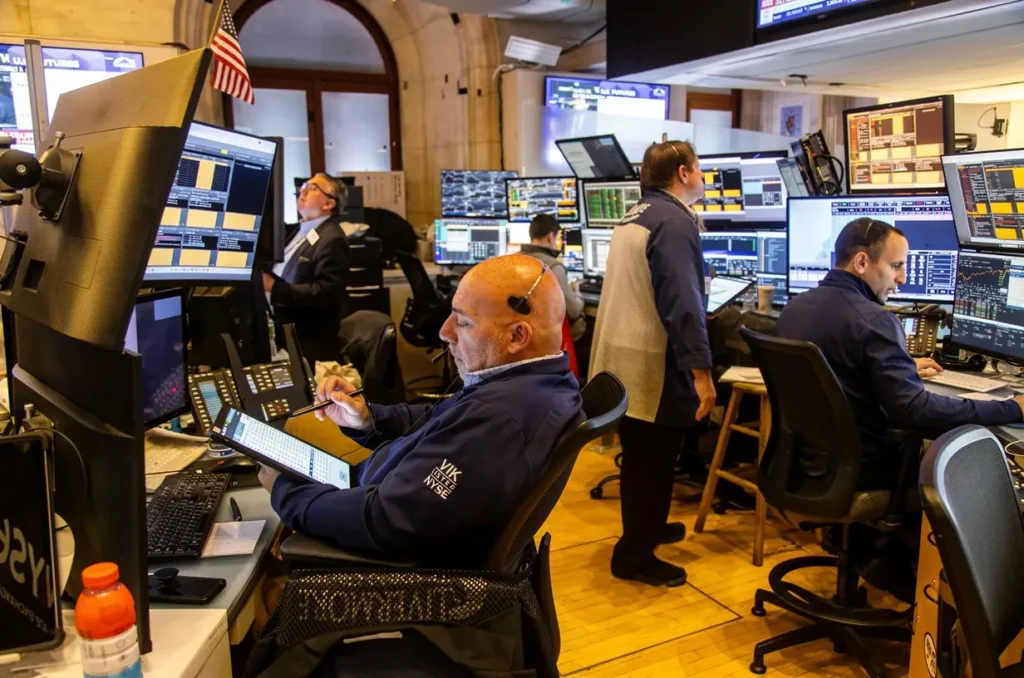
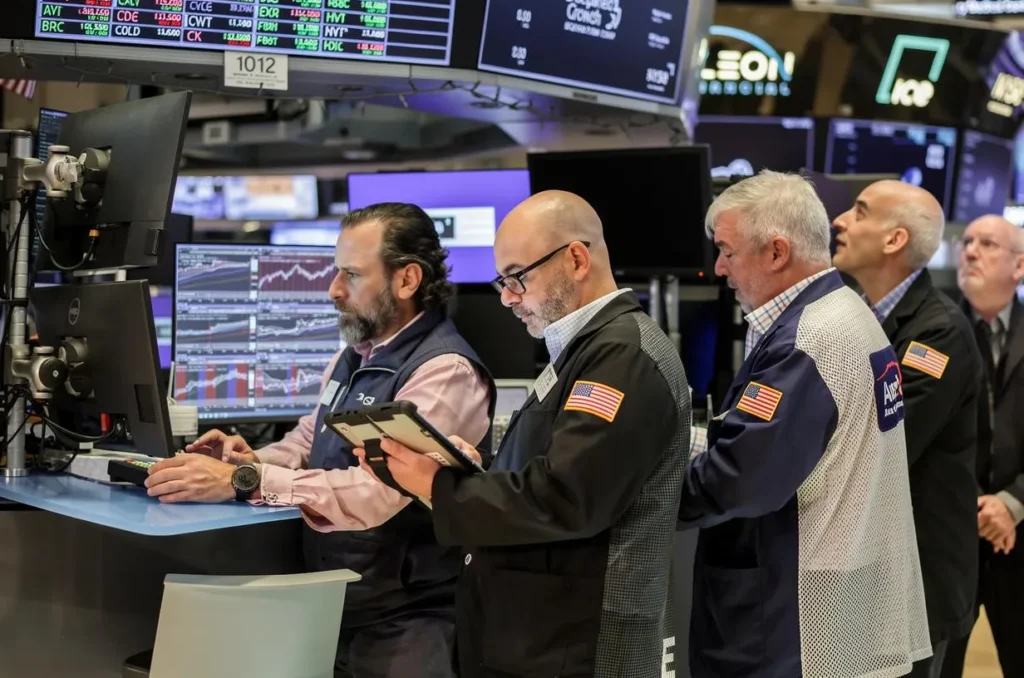
US stocks moved lower Tuesday as renewed pressure across semiconductor shares pulled the Nasdaq into the lead on the downside.
The Nasdaq Composite fell approximately 1.2%, reversing part of Monday’s technology-led rebound. The S&P 500 declined about 0.5%, while the Dow Jones Industrial Average dipped roughly 0.3% after a record-setting session.
The weakness was concentrated in the same area that has driven much of this year’s market leadership: artificial intelligence hardware.
Investors have not abandoned the AI theme. They are becoming more sensitive to any sign that expectations may have moved ahead of achievable returns. Samsung’s results and the DeepSeek report gave the market two reasons to reassess the trade.
Samsung delivered the numbers but not the reassurance
Samsung Electronics reported record second-quarter results, helped by surging demand for memory chips used in AI servers and data centres.
Operating profit increased roughly 19-fold from a year earlier, confirming that the memory cycle remains exceptionally strong. The result was exactly the type of earnings acceleration investors had been expecting from the world’s largest memory-chip maker.
The market reaction was still negative.
Samsung shares fell sharply in Seoul, and the weakness spread across other memory and semiconductor names. The problem was not the reported quarter. The problem was the setup.
Samsung had already rallied heavily into the report, and investors were looking for evidence that AI demand could support another leg higher. Instead, the market focused on whether current profitability may already reflect peak expectations for memory pricing, capital spending and AI hardware demand.
That is the challenge facing the semiconductor sector now. Strong earnings are no longer enough if investors believe the good news has already been priced in.
The chip selloff widened across the sector
The selling pressure moved beyond Samsung.
Nvidia (NVDA) fell, Micron (MU) dropped sharply, and several semiconductor and AI infrastructure stocks gave back the previous day’s gains. The reversal showed that confidence in the chip trade remains fragile after the late-June selloff.
The concern is not that AI demand has disappeared. Data-centre investment remains large, memory prices remain elevated and cloud providers are still building.
The concern is that the market may have priced the sector as if every part of the AI supply chain can grow without friction.
Rising memory costs are already pressuring consumer electronics and auto companies. Semiconductor valuations have expanded quickly. Investors are asking whether AI infrastructure spending can keep accelerating fast enough to justify the capital already committed.
Tuesday’s trading showed that the burden of proof has shifted back to the companies.
DeepSeek added a new competitive risk for Nvidia
Nvidia came under pressure after Reuters reported that Chinese AI developer DeepSeek is working on its own artificial intelligence chip.
The chip is reportedly designed for AI inference, the process of running trained models and generating outputs in response to user prompts. Inference is becoming one of the fastest-growing parts of the AI computing market as models move from development into daily commercial use.
DeepSeek’s effort matters because it points directly at one of Nvidia’s largest long-term growth opportunities.
Training advanced models requires enormous computing clusters. Inference may ultimately require even more total compute as AI tools spread across search, coding, enterprise software, consumer apps and industrial systems.
If major AI developers design their own inference chips, Nvidia could still dominate the highest-performance market, but some workloads may migrate to cheaper, more specialized hardware.
That would not destroy Nvidia’s business. It could narrow the market’s assumption that every new AI workload automatically becomes an Nvidia revenue opportunity.
China is trying to reduce dependence on foreign AI hardware
DeepSeek’s chip effort also fits a larger strategic pattern.
China has been trying to reduce dependence on Nvidia and other foreign suppliers as US export restrictions limit access to the most advanced AI accelerators. Domestic chip design is becoming both a commercial priority and a national industrial strategy.
DeepSeek previously rattled global technology stocks after claiming it could build competitive AI models with fewer chips and lower computing costs than US rivals.
Now the company is reportedly moving deeper into hardware.
The path will not be easy. Designing competitive AI chips requires engineering talent, capital, manufacturing access, advanced memory and a reliable software ecosystem. US restrictions also limit China’s ability to use the most advanced overseas foundries and high-bandwidth memory supply.
Still, the report changes the conversation.
The market is beginning to treat China not only as a demand risk for Nvidia but as a potential competitor in specialized AI hardware.
Inference is the next battleground
The DeepSeek report matters because inference is where the economics of AI may be decided.
Training models is expensive, but it is periodic. Inference happens every time a user asks a question, generates code, produces an image, runs an agent or activates an AI feature inside a software product.
That means inference cost directly affects AI profitability.
Companies running large AI platforms have a strong incentive to reduce the cost per query. Specialized inference chips can be cheaper and more power efficient than general-purpose accelerators if they are designed for specific workloads.
That is why Nvidia faces pressure not only from AMD (AMD) and Broadcom (AVGO), but also from hyperscalers and model developers building internal chips.
Nvidia’s advantage remains formidable. Its hardware, networking and software ecosystem are deeply embedded across the industry. The risk is not immediate displacement. It is margin pressure and share loss in workloads where custom silicon becomes good enough.
Rotation moved into healthcare, energy and real estate
The market’s decline was not uniform.
Real estate, healthcare and energy stocks gained as investors rotated away from high-valuation technology and into sectors with different earnings drivers.
The Health Care Select Sector SPDR ETF (XLV) reached a new high, supported by strength in large-cap pharmaceutical and healthcare companies. Healthcare has become a preferred defensive destination during recent technology pullbacks because demand is less tied to AI capital spending or semiconductor pricing.
Energy also benefited as oil prices rose.
The rotation reinforced a pattern seen throughout the past several weeks. Investors are not leaving equities completely. They are moving capital between sectors as the market debates whether AI leadership can continue without a deeper valuation reset.
Industrials tied to AI infrastructure were hit hard
Some of the hardest selling occurred outside the traditional technology sector.
Caterpillar (CAT) and GE Vernova (GEV) both declined sharply after strong year-to-date gains. Each company has been linked to the AI infrastructure buildout in different ways.
Caterpillar has benefited from demand tied to data-centre construction, power generation and heavy equipment. GE Vernova has been treated as a major beneficiary of rising electricity demand, grid upgrades and turbine orders needed to support AI data centres.
Their weakness shows how far the AI trade has spread.
It is no longer limited to Nvidia, Micron and the semiconductor group. Power equipment, construction machinery, utilities, electrical components and industrial suppliers have all been pulled into the same investment theme.
When investors question AI infrastructure spending, the selling now reaches across the entire supply chain.
Oil rose as Hormuz risk returned
Energy markets moved higher after renewed attacks on commercial ships in the Strait of Hormuz.
Brent crude climbed above $73 per barrel, while West Texas Intermediate moved toward $70. The increase reflected concern that the fragile US-Iran peace process could break down and threaten shipping through one of the world’s most important energy corridors.
The strait had only recently reopened more fully after disruptions tied to the Iran conflict. Traffic had been gradually recovering, helping oil prices move back toward prewar levels.
Renewed attacks changed that calculation.
A sustained disruption would raise crude prices, revive inflation pressure and complicate the Federal Reserve’s policy outlook. It would also increase costs for Asian manufacturers that supply critical components to the AI hardware chain.
Energy risk and technology risk are therefore connected. Higher oil prices can pressure margins, tighten financial conditions and reduce the market’s tolerance for expensive growth stocks.
SpaceX entered the Nasdaq-100 with Wall Street turning bullish
SpaceX (SPCX) also remained in focus as the company entered the Nasdaq-100 shortly after its June IPO.
Major banks initiated coverage following the end of the quiet period, with several launching bullish ratings. JPMorgan, Morgan Stanley and Goldman Sachs all framed SpaceX as a platform spanning reusable rockets, satellite broadband, space infrastructure and AI computing.
The enthusiasm reflects the scale of SpaceX’s addressable markets. Launch services, Starlink connectivity, orbital infrastructure and AI-related compute capacity are all being valued as potentially large long-term businesses.
The stock’s inclusion in the Nasdaq-100 could also force index funds and ETFs tracking the benchmark to buy shares.
The bullish coverage did not prevent broader technology weakness from weighing on the name. SpaceX remains a high-expectation stock, and its valuation depends on businesses that still require enormous capital and technical execution.
SpaceX shows the market still wants frontier growth
SpaceX’s reception shows that investors still have appetite for ambitious technology platforms.
The same market selling semiconductors on valuation concerns is willing to assign large value to a company promising leadership in launch economics, global satellite connectivity and potentially space-based AI infrastructure.
That apparent contradiction reflects a broader market tension.
Investors still want exposure to breakthrough technology. They are simply becoming more selective about where they believe the next stage of growth will come from.
Nvidia, Samsung and Micron must now prove that the current AI hardware boom can keep generating earnings at scale. SpaceX must prove that its long-term platform can support one of the largest valuations in the market.
Both trades depend on confidence in future infrastructure demand.
The market is testing the AI supply chain
Tuesday’s selloff was not a rejection of artificial intelligence.
It was a test of how much investors are willing to pay for each part of the AI supply chain after a dramatic first-half rally.
Samsung’s results confirmed that demand for memory remains powerful. DeepSeek’s chip plans reminded the market that customers and competitors are actively trying to reduce dependence on the most expensive hardware. The pressure on industrial AI beneficiaries showed that the theme has become crowded beyond technology.
The market is moving from the simple phase of the AI trade to the analytical phase.
Early in a cycle, investors buy anything connected to the theme. Later, they begin separating companies with durable earnings, pricing power and defensible market share from companies that simply benefited from narrative momentum.
That is what appears to be happening now.
WSA Take
The Nasdaq’s decline shows that AI optimism is intact but no longer unconditional.
Samsung’s record quarter should have been a clean positive for the chip trade. Instead, it became a reminder that investors had already priced in extraordinary memory demand. DeepSeek’s reported AI inference chip added another pressure point by raising the possibility that major model developers may push harder into custom silicon.
The market is not saying AI spending is ending. It is saying the next round of gains needs better evidence.
For Nvidia, the question is whether inference demand can grow fast enough to offset rising competition from internal chips and China’s domestic hardware push. For memory stocks, the question is whether pricing power can last without damaging downstream demand. For industrial AI beneficiaries, the question is whether data-centre spending translates into earnings rather than just valuation expansion.
The rotation into healthcare, energy and real estate shows investors still want equity exposure. They are simply demanding more discipline from the AI trade.
That makes the next earnings season critical. The chip sector needs to prove that the infrastructure buildout is still accelerating—and that the companies leading it can defend margins, demand and market share as competition widens.
Explore More Stories in Markets
Disclaimer
WallStAccess is a financial media platform providing market commentary and analysis for informational and educational purposes only. This content does not constitute investment advice, a recommendation, or an offer to buy or sell any securities. Readers should conduct their own research or consult a licensed financial professional before making investment decisions.