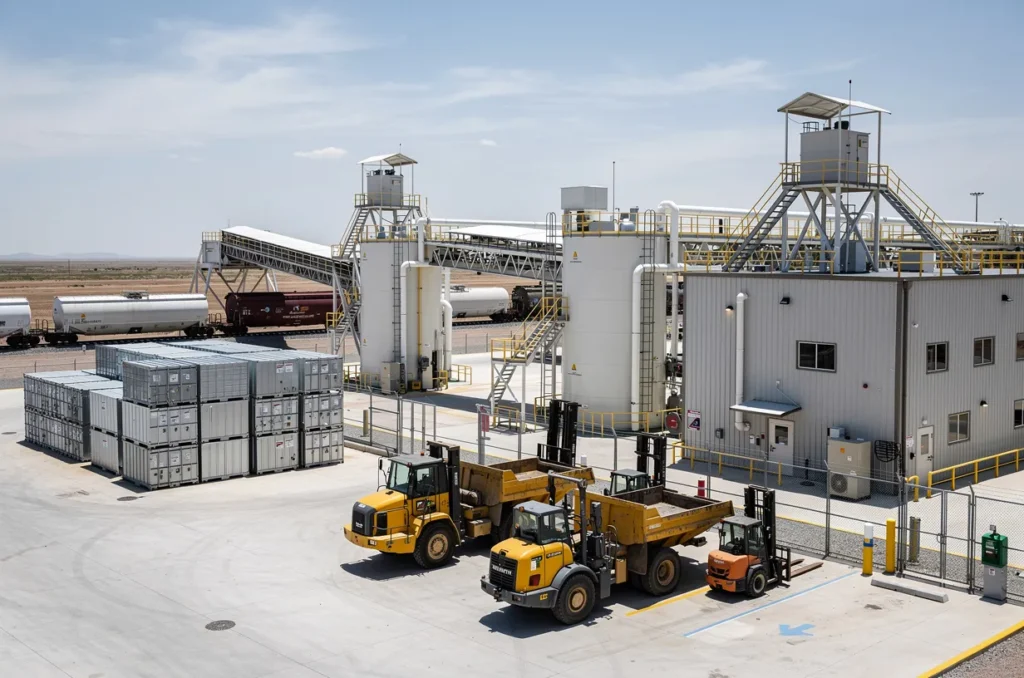
US uranium production is finally moving again
The US uranium industry is showing its clearest signs of recovery in nearly a decade.
Domestic uranium concentrate production rose to 2.1 million pounds U3O8 in 2025, up from 657,000 pounds in 2024. That represents an increase of more than 220% and marks the strongest annual output since 2016, when US mines produced roughly 2.5 million pounds.
The rebound is significant because US uranium production had collapsed over the past decade as low prices, foreign competition and weak domestic investment pushed mines into care and maintenance.
The latest data does not mean the United States has rebuilt a self-sufficient nuclear fuel supply chain. It does show that higher prices and renewed policy support are beginning to pull capacity back into the market.
The recovery is being driven by nuclear demand, energy security and AI power needs
Uranium has become strategically important again.
Nuclear energy is moving back into the centre of US energy policy as electricity demand accelerates. Data centres, artificial intelligence infrastructure, advanced manufacturing and electrification are creating a much steeper long-term power-growth profile than utilities were planning for only a few years ago.
Nuclear power offers something wind and solar cannot provide on their own: large-scale, around-the-clock electricity generation.
That has changed the market’s view of uranium.
For years, uranium was treated as a stagnant commodity tied to an ageing reactor fleet. Investors now see it as a fuel connected to energy security, grid reliability and the power requirements of AI infrastructure.
The shift is supporting higher prices, stronger drilling activity and renewed interest in domestic production.
Drilling activity confirms the industry is rebuilding
The production increase was only one part of the recovery.
Exploration drilling rose nearly 66% in 2025 to just over 1 million feet across 1,824 holes. That was roughly 500 more holes than were drilled in 2024.
Development drilling also increased, reaching approximately 1.3 million feet across 3,708 holes. The footage rose modestly, but the number of holes increased by about 50%.
Combined exploration and development drilling reached the highest level since 2013.
That matters because drilling is the foundation of future production. Exploration identifies new deposits, while development drilling defines existing resources and prepares them for mine planning.
A production rebound without drilling would suggest a short-term restart of existing assets. Rising drilling activity indicates companies are preparing for a longer cycle.
Capital is returning to the sector
Total spending on land, exploration, drilling, production and reclamation reached $234.7 million in 2025.
That was roughly 47% higher than in 2024 and the strongest level since 2014.
The increase reflects improving economics across the sector. Uranium producers and developers are spending more because contract prices, spot prices and political support have all improved.
Capital remains well below the levels required to rebuild a fully domestic fuel cycle, but the trend is moving in the right direction.
After years of underinvestment, even modest increases in spending can produce meaningful changes because so much capacity was idle.
Employment is following production higher
The uranium production industry recorded 711 full-time person-years in 2025, a roughly 40% increase from the prior year.
That was the highest employment level since 2014.
The labour recovery is important because uranium production requires specialized technical, environmental, engineering and operating expertise. Years of low activity weakened the workforce base and made restarts more difficult.
Higher employment suggests companies are rebuilding the operating teams required to run mines, processing facilities and drilling programs.
For states with uranium resources, that creates an economic-development angle alongside the national-security argument. The uranium revival can support technical jobs in regions that already have mining infrastructure and regulatory experience.
ISR remains central to the US production model
Most US uranium production now comes from in-situ recovery, or ISR.
ISR involves injecting a solution underground through wells to dissolve uranium from ore bodies and then pumping the uranium-bearing solution to the surface for processing. The method can avoid the large open pits or underground mine workings associated with conventional mining.
Wyoming remains the centre of US ISR production, while Texas and other western states also play important roles.
Seven of the nine producing US uranium mines in 2025 were ISR operations. That structure matters because ISR projects can sometimes be restarted or expanded more quickly than conventional mines, depending on permitting, wellfield development and processing capacity.
ISR is not simple, but it gives the United States a production pathway that can respond to stronger prices faster than many large conventional mining projects.
Idle capacity is still sitting on the sidelines
The industry’s annual production capacity declined 5% in 2025 to 13.3 million pounds U3O8.
At first glance, that looks negative. In practice, it highlights how much capacity remains available if market conditions continue improving.
At the end of 2025, five ISR plants were on standby with a combined annual capacity of 8.8 million pounds U3O8. Those included Alta Mesa in Texas and Lost Creek, Smith Ranch-Highland, Ross and Willow Creek in Wyoming.
Standby capacity gives the industry optionality.
If utilities sign long-term contracts at attractive prices, more of that capacity can return to production. If prices weaken or contracting slows, restarts may be delayed.
The market is not starting from zero. It has assets, permits, facilities and operating histories that can be reactivated under the right conditions.
2026 has already brought new project momentum
The domestic uranium recovery has continued into 2026.
enCore Energy received federal approval to build its Dewey Burdock ISR project in South Dakota, adding another potential source of future production.
Ur-Energy restarted production at Shirley Basin in Wyoming for the first time since 1992, bringing another historic asset back into the market.
These developments show that the 2025 production increase was not an isolated event. Operators are advancing projects, restarting old mines and preparing for a market in which domestic uranium may command a strategic premium.
The pace will still depend heavily on long-term contracting by utilities. Uranium projects require confidence that buyers will be there for years, not just during short-term price spikes.
The DOE’s reactor financing plan strengthens the long-term demand case
Federal nuclear policy is also becoming more aggressive.
The Department of Energy announced $17.5 billion in conditional loans designed to support the domestic nuclear supply chain and accelerate deployment of 10 large-scale commercial reactors.
The financing is intended to help utilities and energy companies procure long-lead components for new reactor projects, potentially shortening development timelines by up to three years.
The reactors would not create immediate uranium demand. Large nuclear projects take years to permit, build and fuel.
The policy signal is still important.
If the United States is preparing for a new reactor buildout, uranium security becomes more urgent. A larger reactor fleet would require more fuel, more conversion, more enrichment and more domestic supply-chain capacity.
Mine restarts are only the first stage of that process.
The US still depends heavily on foreign uranium and fuel services
The production rebound should not be overstated.
Even at 2.1 million pounds U3O8, domestic mine production remains far below the annual requirements of US nuclear reactors. The United States still depends heavily on imported uranium and foreign fuel-cycle services.
That dependence is exactly why domestic production is receiving more attention.
Uranium supply is not only about mining. The full nuclear fuel chain includes conversion, enrichment and fuel fabrication. Any weak link can expose utilities to price spikes, geopolitical risk or supply restrictions.
The United States has started rebuilding parts of that chain, but it remains early in the process.
Domestic uranium output can improve resilience, but it must be paired with fuel-cycle investment if Washington wants a truly secure nuclear supply base.
Higher prices are doing what policy alone could not
Government support has helped improve sentiment, but prices are what make mines restart.
Uranium producers need contract prices high enough to justify drilling, permitting, wellfield development, processing and reclamation obligations. Many US mines were uneconomic during years of depressed prices.
The recent improvement in uranium markets has changed that calculation.
Utilities are also more willing to sign long-term supply agreements as concerns grow about import dependence, future reactor demand and the availability of fuel from politically reliable jurisdictions.
That contracting activity is crucial. Spot prices attract investor attention, but long-term contracts determine whether producers can finance and operate mines through a full cycle.
The market is moving from survival to expansion
For much of the past decade, the US uranium sector was focused on survival.
Companies maintained permits, preserved assets and waited for prices to recover. Production remained low, employment fell and drilling activity stayed muted.
The latest EIA data suggests the sector has entered a different phase.
Production is rising. Drilling is increasing. Employment is recovering. Spending is back to the highest level in more than a decade. Standby plants provide additional capacity if contract demand strengthens.
This does not guarantee a smooth expansion. Uranium remains a cyclical commodity, permitting remains complex and utilities are cautious buyers.
The direction has changed.
The industry is no longer simply waiting for a recovery. It is beginning to build one.
WSA Take
The US uranium revival is becoming measurable.
Production more than tripled in 2025, drilling reached the strongest level since 2013, employment climbed to the highest level since 2014 and capital spending returned to levels not seen in more than a decade.
The recovery is being driven by a rare alignment of forces: stronger uranium prices, federal support for nuclear energy, energy-security concerns and rising electricity demand from AI data centres.
The United States is still far from self-sufficient. Domestic output remains small compared with reactor requirements, and the broader fuel cycle still depends heavily on foreign supply.
That gap is the investment case.
If Washington wants more nuclear power and less foreign fuel dependence, US uranium production must continue growing. The 2025 data shows that the restart has begun. The next test is whether utilities, policymakers and capital markets support the sector long enough to turn idle capacity into sustained production.
Explore More Stories in Commodities
Disclaimer
WallStAccess is a financial media platform providing market commentary and analysis for informational and educational purposes only. This content does not constitute investment advice, a recommendation, or an offer to buy or sell any securities. Readers should conduct their own research or consult a licensed financial professional before making investment decisions.