Ford is locking in memory supply before the shortage becomes worse
Ford has signed a long-term semiconductor supply agreement with Micron Technology, giving the automaker more secure access to memory and storage products for its next generation of vehicles.
The agreement comes as cars become more data-intensive and memory chips become more strategically important to the auto industry. Advanced driver-assistance systems, infotainment platforms, connectivity features, over-the-air software updates and future autonomous functions all require more memory and storage than traditional vehicles.
For Ford, the deal is a supply-chain insurance policy.
Automakers learned during the pandemic that a shortage of relatively inexpensive chips can stop production of vehicles worth tens of thousands of dollars. The next shortage risk is not only basic microcontrollers. It is increasingly advanced memory, where demand from artificial intelligence data centres is absorbing capacity that also serves autos, smartphones, PCs and industrial systems.
Micron is becoming a strategic supplier to Detroit
The Ford agreement follows a similar long-term deal between Micron and General Motors.
Together, the two agreements show that US automakers are treating memory supply as a long-term strategic issue rather than a routine procurement category.
Micron said the Ford deal is one of 16 strategic customer agreements discussed during its fiscal third-quarter earnings call. Those agreements cover customers across data-centre, consumer and automotive markets and are designed to give buyers committed supply over multiple years.
Automotive agreements generally have shorter terms than some of Micron’s largest data-centre contracts, but they still provide more visibility than standard spot-market purchases.
For Ford and GM, the agreements reduce exposure to sudden price spikes and allocation cuts.
For Micron, they create a more predictable revenue base and deepen customer relationships in a market that is becoming more important as vehicles shift toward software-defined architectures.
AI demand is changing the auto supply chain
The core issue is competition for memory.
AI servers require enormous amounts of DRAM, high-bandwidth memory, NAND storage and data-centre solid-state drives. Hyperscale cloud providers are buying aggressively to support training, inference and enterprise AI workloads.
That demand has lifted memory prices and tightened supply across the broader market.
DRAM prices have risen roughly 70% since December, according to industry reporting. The pressure has already affected consumer electronics, with some manufacturers raising prices to offset higher component costs.
Automakers now face the same problem.
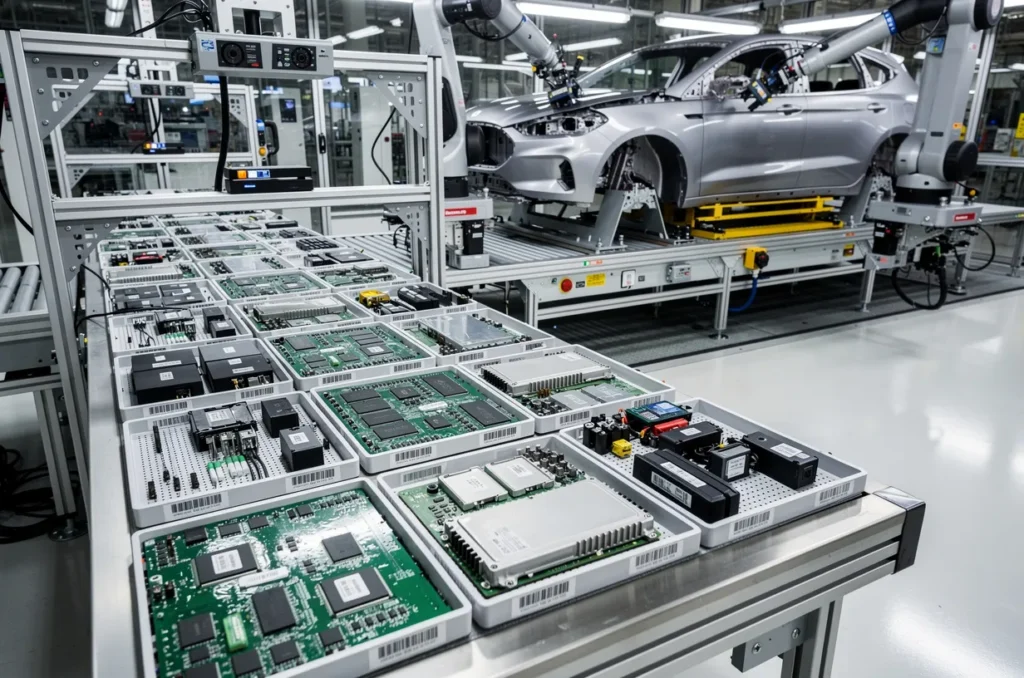
A modern vehicle may contain dozens of electronic control units, cameras, sensors, displays and domain controllers. As vehicles consolidate computing into centralized architectures, memory requirements increase further.
The auto industry is no longer competing only with other automakers for chips. It is competing with the largest cloud and AI companies in the world.
Vehicles are becoming rolling data centres
Ford’s next-generation vehicles will rely on more powerful onboard computing systems.
That shift changes the semiconductor content of the vehicle.
Traditional cars used many smaller electronic control units that performed specific functions. Newer designs increasingly use centralized or zonal computing architectures that process more data in fewer, more powerful systems.
Those systems require fast memory and reliable storage.
Advanced driver-assistance features must process camera, radar and sensor data in real time. Infotainment platforms must support large displays, app ecosystems, voice assistants and connected services. Electric vehicles also require sophisticated battery-management and power-control systems.
Every one of those functions increases the value of dependable memory supply.
The more intelligent the vehicle becomes, the more exposed the automaker becomes to memory availability and pricing.
Micron’s US manufacturing footprint matters
Micron said the Ford agreement is supported by its investments to expand and localize manufacturing for automotive customers, including advanced DRAM production at its Manassas, Virginia facility.
That location is important.
Automakers and policymakers are trying to reduce dependence on overseas semiconductor supply chains after years of disruption. Domestic chip production does not eliminate all risk, but it can improve resilience for critical programs and reduce exposure to export controls, shipping delays and geopolitical shocks.
Ford CEO Jim Farley emphasized the importance of a resilient supply chain for high-volume vehicles produced in the United States.
For Micron, US manufacturing is becoming a commercial advantage. Customers are not only buying memory. They are buying supply assurance from a domestic producer with long product lifecycles and automotive qualification capabilities.
The agreement fits Micron’s new business model
Micron is attempting to change the economics of the memory business.
Memory has historically been highly cyclical. Prices rise when supply is tight, producers add capacity, the market eventually becomes oversupplied and prices fall sharply. That boom-bust pattern has made earnings difficult to forecast.
Strategic customer agreements are Micron’s attempt to smooth that cycle.
The company has said many of these agreements include binding volume commitments, pricing bands or other structures that give customers supply visibility while giving Micron greater revenue predictability.
For customers, the appeal is access to scarce memory during a shortage.
For Micron, the appeal is a more durable business model with committed demand and stronger margin visibility.
The Ford agreement shows that this model is not limited to cloud providers. Automotive customers also want more certainty.
Automakers cannot afford another chip shock
The auto industry is still carrying scars from the last semiconductor shortage.
During the pandemic, automakers cut orders as demand initially weakened. Consumer demand then recovered faster than expected, but chip capacity had already shifted toward other industries. Vehicle production stalled, dealer inventories collapsed and prices surged.
This time, the pressure is coming from a different direction.
AI data-centre spending is pulling memory capacity toward higher-margin server products. That can leave automotive customers exposed, especially because vehicles often require long-qualified components that cannot be swapped quickly.
Automakers typically design chips into vehicle platforms years before production. Once a model is validated, changing components can require testing, safety reviews and regulatory work.
That makes long-term supply agreements valuable. They reduce the odds that an otherwise ready vehicle program gets delayed by a memory shortage.
Ford is preparing for more software-defined vehicles
The agreement also supports Ford’s broader push toward connected, software-driven vehicles.
Automakers are trying to generate more revenue after the initial sale through driver-assistance features, subscriptions, fleet software, data services and over-the-air updates. Those business models require vehicles with enough onboard computing power and storage to support software upgrades over many years.
That creates a different procurement problem.
A vehicle platform may stay in production for years and remain on the road for more than a decade. The memory used in those vehicles must remain available, reliable and compatible with long product lifecycles.
Micron specifically highlighted the importance of supporting long product lifecycles in automotive memory.
That is one reason automotive supply agreements can be strategically important even when they are smaller than hyperscaler contracts.
The GM deal shows this is becoming an industry pattern
Micron’s agreement with General Motors, announced days earlier, covered long-term supply for memory and storage platforms used in GM vehicles.
The Ford deal suggests that major automakers are moving quickly to secure similar arrangements rather than waiting for supply conditions to worsen.
This is a shift from the traditional purchasing approach, where automakers often pushed suppliers for lower prices and leaned on just-in-time inventory models.
Memory is becoming too important for that strategy.
The industry is moving toward longer-term commitments because the cost of not having chips is far higher than the cost of carrying more supply assurance.
Memory suppliers have more leverage than they used to
Micron’s negotiating position has improved materially.
AI demand has elevated memory from a commodity component to a strategic technology. High-bandwidth memory is central to AI servers, while DRAM and NAND remain essential across consumer electronics, enterprise systems and vehicles.
Supply remains tight, and new fabrication capacity is slow to build.
That gives memory producers more pricing power and more ability to structure long-term agreements on favorable terms.
Automakers do not have unlimited leverage in that environment. Their volumes are large, but the highest-growth demand is coming from data centres, where customers may be willing to pay more for priority supply.
Ford’s agreement with Micron is therefore both a supply-chain move and a recognition of the new bargaining power held by memory manufacturers.
WSA Take
The Micron-Ford agreement is not a routine supplier announcement. It is a sign that the auto industry is being pulled into the same memory shortage reshaping AI, consumer electronics and cloud infrastructure.
Ford is securing long-term access to memory and storage because next-generation vehicles are becoming more software-defined, more data-intensive and more dependent on advanced computing. GM has already made a similar move, suggesting this will become standard practice among major automakers.
For Micron, the agreement strengthens its effort to move away from the traditional boom-bust memory cycle. Strategic customer agreements give the company more predictable demand, stronger customer relationships and better visibility into future revenue.
The larger market signal is clear. AI data centres are no longer just competing with other AI customers for chips. They are competing with automakers, smartphone makers and industril companies for the same constrained memory supply.
In that environment, companies with secured access to memory will have an advantage. Companies still relying on the spot market may find themselves paying more—or waiting longer—when the next supply crunch hits.
Disclaimer
WallStAccess is a financial media platform providing market commentary and analysis for informational and educational purposes only. This content does not constitute investment advice, a recommendation, or an offer to buy or sell any securities. Readers should conduct their own research or consult a licensed financial professional before making investment decisions.