Diplomacy is finally taking some heat out of oil
Oil prices eased Friday as traders received the clearest indication yet that Washington and Tehran may be working toward a phased end to the conflict.
Negotiators in New York are discussing a framework that could include Iran reopening the Strait of Hormuz in exchange for the U.S. easing its economic blockade, according to people familiar with the talks. Before the conflict, roughly 20% of global oil supply moved through the strait.
The possibility of restoring normal traffic through one of the world’s most important energy chokepoints was enough to outweigh another round of attacks in the region, at least for now.
Friday’s market showed the split clearly:
- Brent: about $105.46 per barrel, up roughly 2% for the week
- WTI: about $93.56 per barrel, down roughly 7% for the week
That divergence is more interesting than Friday’s 1% decline.
The barrels are moving, but the system is still fragile
Oil is continuing to make its way through Hormuz despite the war. Kpler tracked roughly 33.7 million barrels crossing the strait so far this week, broadly in line with the previous week. Most of those cargoes came from Saudi Arabia and Iraq.
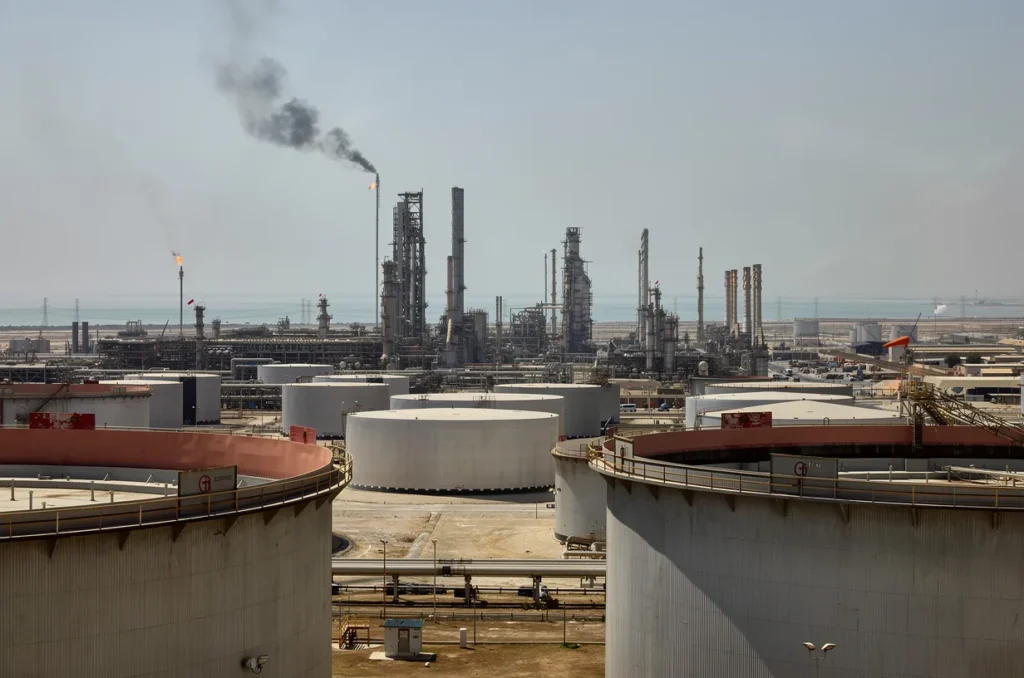
Saudi Arabia has also restarted its East-West pipeline after attacks damaged the system earlier this month, although Reuters reported that full capacity may take six to eight weeks to restore. The line can move crude toward the Red Sea and bypass Hormuz altogether.
The problem is that almost every alternative now carries additional risk or cost. Houthi attacks continue to threaten Saudi infrastructure, while ship-to-ship transfers used to keep Gulf crude moving have pushed some tanker costs above $30 per barrel.
Oil supply has adapted remarkably well. It has not returned to normal.
Why Brent and WTI are moving apart
The widening gap between Brent and WTI adds another layer to the trade.
Brent reflects a global market still paying for Middle East disruption. WTI is facing a different problem at home: Washington is considering restrictions on U.S. diesel exports as record fuel prices hit consumers and businesses.
The U.S. is the world’s largest diesel exporter. Keeping more diesel inside the country could eventually force refiners to cut crude processing if inventories fill too quickly, reducing demand for U.S. crude and pushing WTI lower relative to Brent. The Brent premium over WTI has now reached its widest level since May.
That explains why the two benchmarks can move so differently even while they trade the same geopolitical backdrop.
A successful U.S.-Iran agreement could remove a meaningful portion of the global risk premium, especially if Hormuz returns to normal operation. But another serious hit to Saudi infrastructure would quickly tighten the physical market again.
Oil is no longer trading on a simple question of war or peace. It is trading on whether the world’s energy system can keep enough barrels moving while politics, damaged infrastructure and refining constraints pull supply in different directions.
Explore More Stories in Commodities
Disclaimer
Wall Street Access is an independent financial publisher. Wall Street Access is not a financial advisor. No company mentioned has compensated Wall Street Access for the preparation, publication or distribution of this article. This content is provided for informational and educational purposes only and is not investment advice or a recommendation to buy, sell or hold any security. Investing involves risk, including the possible loss of principal.
Prices, market capitalizations, financial figures and other market data are based on information available as of the date and time of publication and may change without notice. Information is drawn from public sources believed to be reliable but is not guaranteed to be complete or accurate. Opinions and expectations expressed are our own and may change as new information becomes available.
Readers should conduct their own due diligence and contact a licensed financial professional before making any investment decision. Past performance does not guarantee future results. Any material ownership interest or conflict of interest, where applicable, will be disclosed separately.