
An unusual place to look for defense
Calling Big Tech defensive takes some explaining.
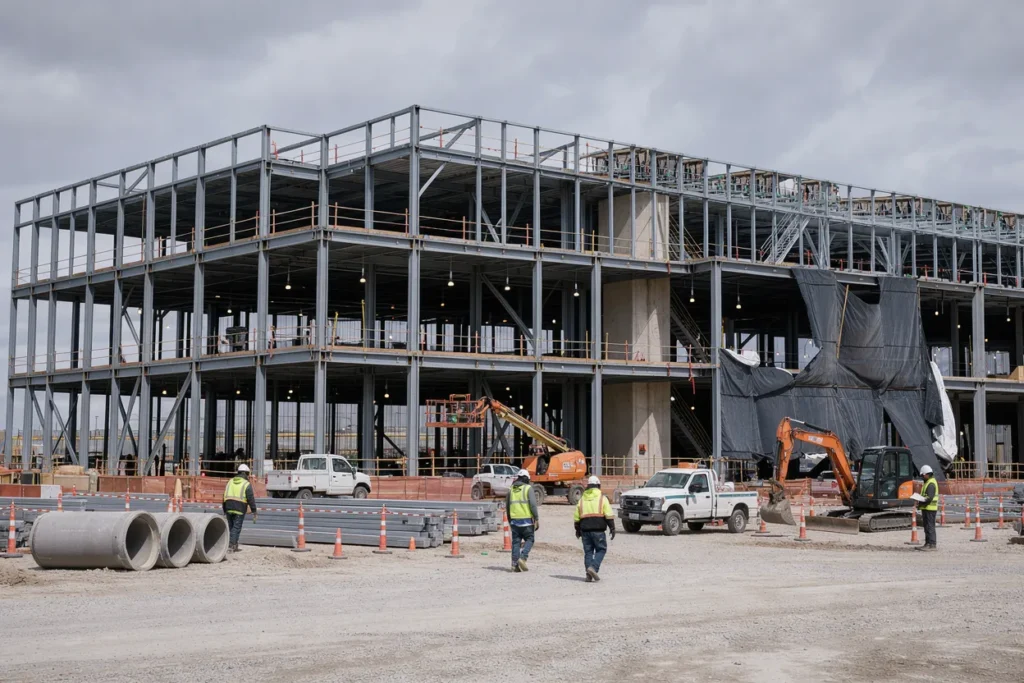
These are companies committing enormous sums to AI infrastructure, with cash leaving the business years before some of the expected returns arrive. Their spending has become one of the market’s biggest sources of anxiety.
Goldman Sachs sees a different balance after the sell-off.
The bank expects the S&P 500 to reach 8,700 over the next 12 months, roughly 14% above Thursday’s close. Its strategists favor US and Japanese equities while remaining underweight Europe.
The appeal of the hyperscalers—the technology giants operating vast computing networks—rests on established businesses, financial resources and valuations that have fallen alongside confidence.
As earnings growth becomes harder to find, companies capable of sustaining it could regain a premium. Big Tech’s defensive case depends on the strength of those existing businesses carrying an expensive investment cycle through to worthwhile returns.
A cash-flow deficit needs context
Alphabet offers a useful example of the tension.
The company generated $42.3 billion in operating cash flow in the third quarter but spent $51.4 billion on capital expenditures. That left negative free cash flow of $9.1 billion.
Its operations were still generating substantial cash. Investment exceeded it, with inventory spending and a $5.2 billion European Commission fine payment also weighing on the quarter.
The picture also changes with the timeframe: Alphabet reported positive free cash flow of $19.7 billion over the trailing 12 months.
Microsoft, meanwhile, produced $18.6 billion in free cash flow in its quarter ended September 30 and expects to remain free-cash-flow positive in fiscal 2027.
That makes sweeping descriptions of hyperscalers’ cash burn less useful. The companies have different spending schedules, financing arrangements and operating businesses.
Financial strength buys time. The eventual return on the infrastructure still determines whether that time was well spent.
The 2027 outlook will change as companies revise budgets and customers turn AI usage into revenue. Wall Street Access follows those developments across emerging sectors and public companies.
Follow the Businesses Behind the Bullish Forecasts
Slower growth changes what the market rewards
Goldman projects S&P 500 earnings growth slowing from 36% in 2026 to 11% in 2027.
Eleven percent still represents expanding profits. The more important change is how much less exceptional the growth becomes—and where it comes from.
In separate research published in September, Goldman estimated that large technology companies recorded approximately $150 billion in unrealized investment gains in the second quarter. Those gains represented about 12% of S&P 500 earnings per share for that quarter.
Such gains can lift reported profits without bringing in cash from customers. A smaller contribution next year would make the comparison harder even if underlying businesses continued expanding.
The same research anticipates a gradual shift from earnings supported by AI construction spending toward profits supported by AI productivity.
That shift has different consequences across the industry. Suppliers benefit when equipment is ordered. The companies buying it need higher revenue, better utilization or efficiency gains to justify the outlay.
A slower increase in spending could ease the buyers’ cash burden while reducing the growth impulse reaching suppliers.
The valuation case still needs earnings to hold up
The S&P 500 trades at approximately 18.5 times forward earnings, down from recent levels above 23 times.
That is a market-wide measure, rather than a valuation for every hyperscaler. It also rests on forecasts that can change.
Goldman’s September research made the limitation clear: an ordinary earnings multiple can still be expensive when the earnings underneath it are unusually elevated.
Its constructive outlook also assumes relief from inflation and bond yields. Friday’s producer-price report showed prices excluding food, energy and trade services rising 0.5% in October and 4.9% over 12 months, leaving that relief uncertain.
The next company budgets will help test the other side of the argument. Alphabet expects capital expenditure to increase significantly in 2027 and plans to provide more detail on its fourth-quarter earnings call.
The case for a recovery becomes stronger when earnings endure, investment produces cash and financing pressure eases. Lower valuations have improved the arithmetic; the businesses still have to deliver.
Explore More Stories in Markets
Disclaimer
Wall Street Access is an independent financial publisher. Wall Street Access is not a financial advisor. No company mentioned has compensated Wall Street Access for the preparation, publication or distribution of this article. This content is provided for informational and educational purposes only and is not investment advice or a recommendation to buy, sell or hold any security. Investing involves risk, including the possible loss of principal.
Prices, market capitalizations, financial figures and other market data are based on information available as of the date and time of publication and may change without notice. Information is drawn from public sources believed to be reliable but is not guaranteed to be complete or accurate. Opinions and expectations expressed are our own and may change as new information becomes available.
Readers should conduct their own due diligence and contact a licensed financial professional before making any investment decision. Past performance does not guarantee future results. Any material ownership interest or conflict of interest, where applicable, will be disclosed separately.