
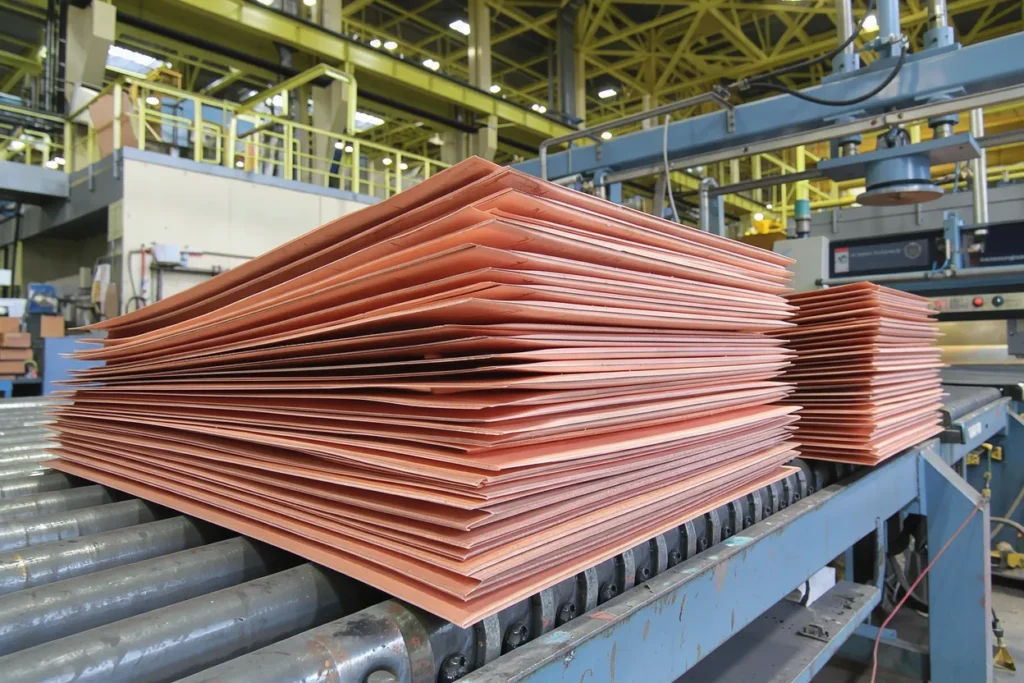
Enough copper on paper doesn’t guarantee a delivery
A factory needs copper for next month’s production. Somewhere, there is a warehouse full of it. Whether the owner wants to sell—and whether shipping it makes financial sense—is another question.
That is the problem behind an unusually wide split in copper forecasts.
Deutsche Bank’s Daniel Ghali sees prices reaching $10 a pound by the second quarter of 2027, roughly $22,050 per metric tonne. His argument centers on stockpiles increasingly concentrated in the US and China, leaving less metal available elsewhere.
Goldman Sachs is questioning whether its own $15,400-a-tonne forecast for 2027 is too optimistic.
Copper’s next squeeze could come from metal being held back from trade, even while global production exceeds consumption. The location of a stockpile—and the incentive to release it—can matter as much as its size.
The forecasts aren’t measuring the same thing
First, the price comparison needs some care.
Deutsche Bank’s $10 call is a midyear price target. Goldman’s figures are annual averages. A brief spike and a much lower yearly average could occur in the same market.
In its latest assessment, Goldman outlined a $14,600 average if investor positioning remains at current levels, or approximately $14,500 if lower tariff expectations weaken US stockbuilding. Those scenarios translate to roughly $6.62 and $6.58 a pound.
The bank’s concern is that money tied to the AI trade could retreat faster than physical consumption changes. A manufacturer can keep buying copper while financial investors sell futures.
So this is more nuanced than one bank calling a boom and another predicting a collapse. They disagree over how strongly scarcity will reach the price.
A surplus is an annual balance, not a warehouse map
The International Copper Study Group projects a refined copper surplus of 368,000 tonnes in 2027, up from 104,000 tonnes in 2026.
It expects refined output to grow 3.4%, faster than the 2.5% increase in usage, helped by expanding facilities in Indonesia, India and the European Union.
That is meaningful supply growth. It does not establish that every industrial buyer will have easy access to it.
A surplus measures production against usage over a period. Accessible inventory measures what can actually be bought and delivered. Metal accumulated as a strategic reserve or held for a tariff-related trade can add to stocks without easing another region’s immediate needs.
Ghali’s argument depends on those holdings staying difficult to access. Inventory estimates remain uncertain, particularly where stocks are unreported; a shortage of available metal is not the same as the world physically running out.
That leaves this story moving between warehouses and Washington. WSA follows the policy decisions, emerging sectors and equities connected to those shifts.
Get the Metals Stories Moving Markets, Directly to Your Inbox
Washington can change the supply picture without opening a mine
The Commerce Department recommended refined-copper tariffs of 15% from January 2027, rising to 30% in January 2028. The presidential proclamation provided for a subsequent decision on whether those duties were warranted; it did not automatically enact them.
That distinction matters. A proposed tariff can move metal before an actual tariff collects a dollar.
Importers may bring purchases forward to avoid future duties. If expectations fade, the incentive to accumulate stock weakens. Goldman sees further downside if substantial US inventories flow back into international markets.
Neither outcome requires a change in mine production.
The difference will show up in deliveries
For miners, stronger copper prices can support revenue, provided production and costs hold up. Manufacturers face a different calculation: a lower benchmark offers limited relief if physical delivery still carries a steep premium.
A recession could also break the scarcity argument by reducing industrial buying. Conversely, resilient consumption could keep pressure on available stocks without an AI spending acceleration.
The test arrives with 2027’s tariff decisions and inventory movements: does additional refined output reach consumers, or does it join stockpiles they cannot readily buy?
Explore More Stories in Commodities
Disclaimer
Wall Street Access is an independent financial publisher. Wall Street Access is not a financial advisor. No company mentioned has compensated Wall Street Access for the preparation, publication or distribution of this article. This content is provided for informational and educational purposes only and is not investment advice or a recommendation to buy, sell or hold any security. Investing involves risk, including the possible loss of principal.
Prices, market capitalizations, financial figures and other market data are based on information available as of the date and time of publication and may change without notice. Information is drawn from public sources believed to be reliable but is not guaranteed to be complete or accurate. Opinions and expectations expressed are our own and may change as new information becomes available.
Readers should conduct their own due diligence and contact a licensed financial professional before making any investment decision. Past performance does not guarantee future results. Any material ownership interest or conflict of interest, where applicable, will be disclosed separately.