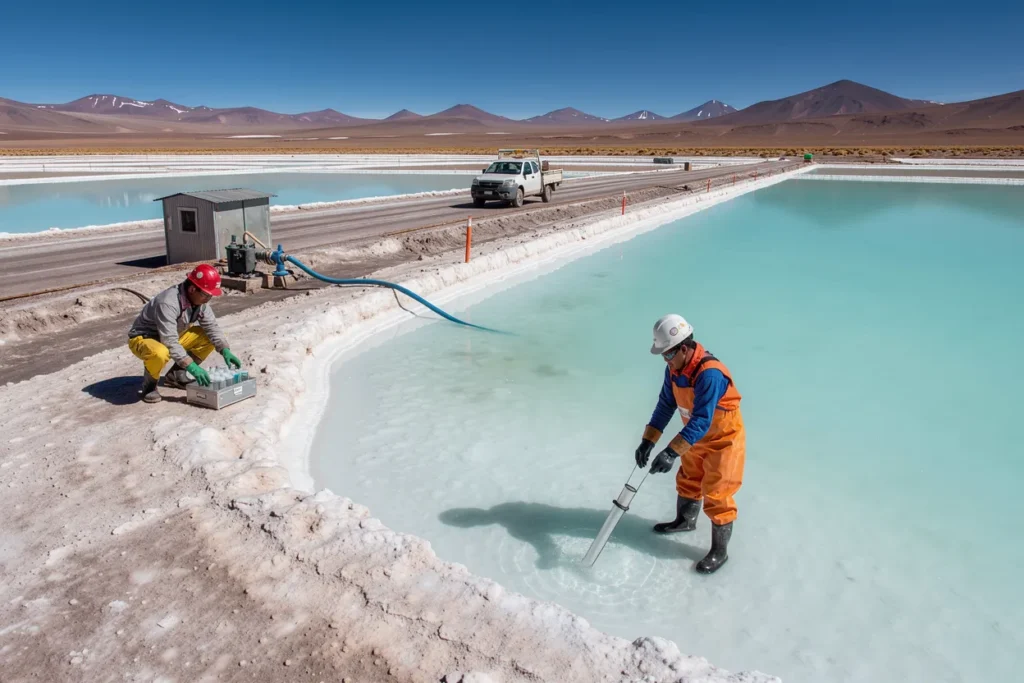
The next leap starts at a familiar salt flat
Chile’s next big lithium investments start with a familiar place: the Salar de Atacama. The proposed change is how much lithium companies can recover from its brine—and what they leave behind.
The country’s mining investment pipeline has reached $111.1 billion across 72 projects for 2026–2035, its highest level in 13 years. Lithium spending more than doubled to $10.8 billion, accounting for roughly 92% of the increase over the previous survey.
Almost all that lithium increase comes from two developments: Albemarle’s $3.1 billion extraction project and Novandino Litio’s $3 billion Salar Futuro, a partnership between Codelco and SQM. Both remain under environmental review. COCHILCO
That makes the headline a measure of ambition. How much becomes production depends on whether new extraction systems can earn approval, justify their costs and work reliably at industrial scale.
Getting more lithium out of the same resource
Traditional brine operations use evaporation ponds to concentrate lithium-bearing saltwater. Direct lithium extraction, or DLE, uses processes that selectively capture lithium from the liquid, commonly through adsorption or ion exchange. IEA
For established producers, the attraction is straightforward: recover more of the lithium already passing through an operation while reducing dependence on evaporation.
Albemarle (NYSE: ALB) says its proposed process could recover nearly twice as much lithium while reducing net brine extraction. Its La Negra pilot plant achieved recovery rates above 94%, according to the company.
That is encouraging technical evidence. It does not yet establish the operating cost or environmental performance of a full-scale installation.
Albemarle plans to return lithium-depleted brine to the salt flat under monitoring. Its modular design would allow additional processing lines to be introduced gradually, with expansion dependent on environmental conditions and economics. albemarle.com
The technology and the permit are closely connected: how the process handles brine helps determine whether—and under what conditions—it can expand.
Those decisions will shape future supply well beyond Chile. WSA follows the projects, technologies and listed companies moving critical minerals toward production.
Find Which Mineral Projects Are Moving Forward
Approval starts another clock
Even a successful environmental review would leave years of work ahead.
SQM (NYSE: SQM) says Salar Futuro’s approximately $3 billion investment would be deployed over seven years after the required approvals, with the heaviest spending expected in years three and four. The project combines higher-recovery technologies with changes to existing production processes. ir.sqm.com
Albemarle also requires a final investment decision before proceeding. Its initial phase would include the first DLE production line and an electrical transmission connection. albemarle.com
These schedules matter to the wider lithium market. A larger investment pipeline can signal confidence in long-term demand without creating an immediate surge in available supply.
For producers, spending arrives before the additional sales. For equipment suppliers and contractors, opportunities emerge as individual phases receive funding and orders.
Copper shows why spending and supply can tell different stories
Copper still represents 84.5% of Chile’s planned mining investment.
But a large budget does not always mean a comparable increase in production. BHP’s $1.3 billion Escondida leaching project, for example, aims to maintain annual output of 210,000 tonnes of copper cathodes. COCHILCO
Some capital expands supply. Some keeps existing supply from declining.
Chile’s outlook contains both, which helps explain how substantial mining investment can coexist with concerns about future mineral availability.
The next concrete steps for its two largest proposed lithium developments are environmental decisions and funding commitments. Those will begin to establish when years of engineering can become construction—and when improved recovery can become saleable lithium.
Explore More Stories in Commodities
Disclaimer
Wall Street Access is an independent financial publisher. Wall Street Access is not a financial advisor. No company mentioned has compensated Wall Street Access for the preparation, publication or distribution of this article. This content is provided for informational and educational purposes only and is not investment advice or a recommendation to buy, sell or hold any security. Investing involves risk, including the possible loss of principal.
Prices, market capitalizations, financial figures and other market data are based on information available as of the date and time of publication and may change without notice. Information is drawn from public sources believed to be reliable but is not guaranteed to be complete or accurate. Opinions and expectations expressed are our own and may change as new information becomes available.
Readers should conduct their own due diligence and contact a licensed financial professional before making any investment decision. Past performance does not guarantee future results. Any material ownership interest or conflict of interest, where applicable, will be disclosed separately.