The rebound follows AI’s connections
A strong report from a cloud provider can lift companies that never rent out a single server. That is how connected the AI trade has become.
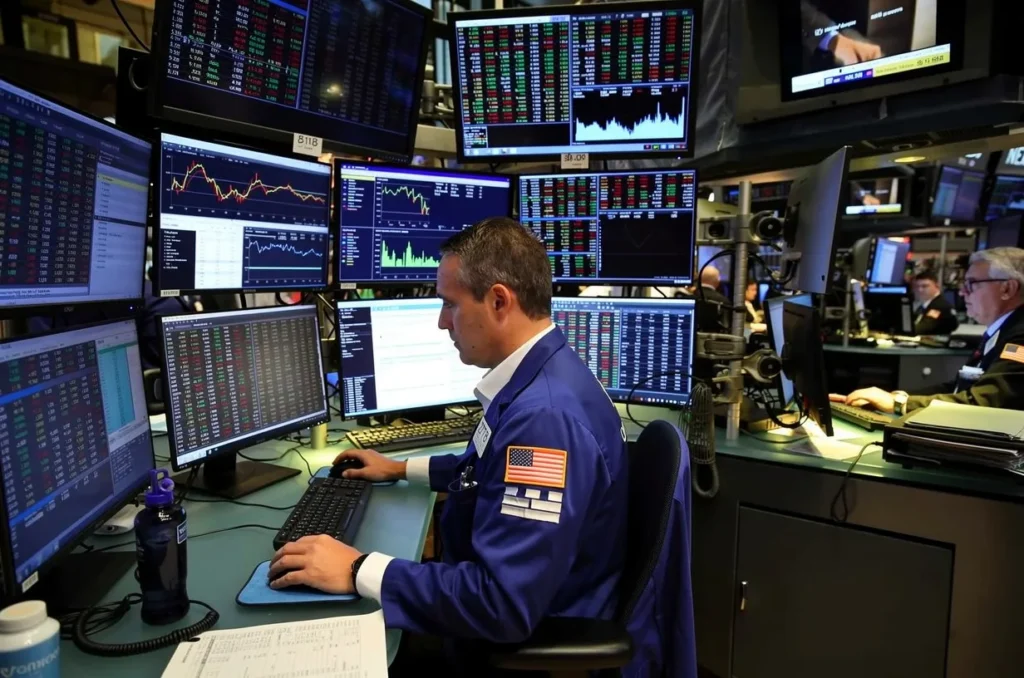
Wednesday’s recovery followed those connections. At 10:45 a.m. Eastern, the S&P 500 rose 1% and the Nasdaq gained 1.6%, while the Dow slipped 0.1%.
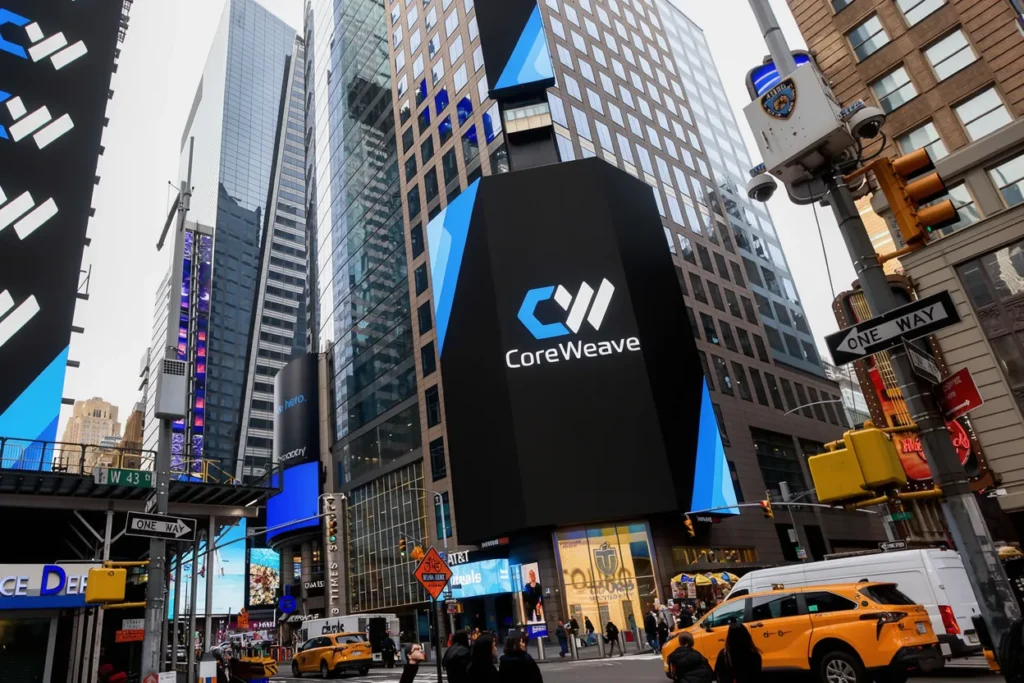
The catalyst was familiar: evidence that customers still need more computing power. CoreWeave (NASDAQ: CRWV) raised its full-year revenue forecast to $13 billion–$13.3 billion, reassuring a market that had begun questioning the pace of AI expansion.
That reassurance travelled quickly through the suppliers. Micron (NASDAQ: MU) gained 11.7%, Broadcom (NASDAQ: AVGO) added 5.3% and Nvidia (NASDAQ: NVDA) rose 3.2%.
The spending lifting technology stocks is also adding to the price pressures keeping the Federal Reserve on alert. AI’s growth is becoming part of the interest-rate debate that determines how expensive its next phase will be.
Confidence is still attracting capital
Step back from the daily swings and the industry’s commitments continue to grow.
Taiwan Semiconductor Manufacturing (NYSE: TSM) approved investments of up to $500 million each in Anthropic and OpenAI. Its Anthropic investment would purchase common shares at the IPO price; the OpenAI investment would acquire preferred stock.
These are board approvals, with investment limits, rather than confirmation that every dollar has been deployed.
They nevertheless show how closely the companies building AI hardware are aligning themselves with the developers using it. The chip supply chain has a financial interest in the applications succeeding, alongside its interest in selling the equipment.
That helps explain the speed of Wednesday’s rebound. A healthier outlook for computing demand reaches well beyond any one cloud company.
It also makes disappointing news harder to contain.
An earnings forecast, a financing agreement or a Fed speech can move the same group of stocks for very different reasons. Wall Street Access connects those developments, so the next morning’s headlines come with the context behind them.
Wake Up to the Story Behind the Market’s Next Move
Nvidia has a separate uncertainty to resolve
For Nvidia, improving industry sentiment offers relief alongside an unfinished corporate review.
Its independent directors retained Joon H. Kim and Wachtell, Lipton, Rosen & Katz to conduct the investigation involving CEO Jensen Huang.
The board’s original statement said it had no reason to believe national security or company secrets had been compromised. The review concerns reports that Huang was targeted by a foreign intelligence effort; those allegations remain under investigation.
A recovery in the shares reflects a change in trading sentiment. The investigation’s findings will provide the substantive answers.
The Fed sees another side of the boom
The same expansion looks different from inside a central bank.
In remarks on Tuesday, Fed Vice Chair for Supervision Michelle Bowman attributed roughly one-quarter of above-target core PCE inflation over the year through September to AI-related price pressures. That was her assessment of the excess above target, rather than a quarter of all inflation.
Her explanation was straightforward: investment demand has shifted rapidly toward high-tech equipment whose supply cannot expand as quickly.
For suppliers, that can support pricing. For the businesses buying the equipment, it raises the cost of expansion.
Bowman also expects AI adoption to improve productivity and eventually help lower prices. The spending arrives before all of those efficiency gains do. That timing matters for monetary policy.
Tuesday’s 0.4% monthly CPI increase, with core prices rising 0.3%, reinforced the difficulty. Fed Governor Christopher Waller had identified core inflation around 0.3% or higher as grounds to consider a half-point December rate increase. That remains a policy possibility, rather than a decision.
Wednesday’s recovery was also uneven: slightly more S&P 500 constituents declined than advanced. Large technology gains can carry an index while other businesses struggle with higher financing costs.
With the Treasury market closed for Veterans Day, stocks had a day without a fresh cash-bond-market response. The inflation question returns with producer prices on November 13 at 8:30 a.m. Eastern. Nvidia’s November 17 earnings call will then offer another test of demand.
The rebound has renewed support from customers’ appetite for AI. Its durability still depends on what that growth costs—and how much profit remains after the bills are paid.