Brazil wants to move up the supply chain
Brazil has the geology. Now it wants more of the economics.
The U.S. is signaling that it may support the development of critical-minerals processing and refining capacity inside Brazil as Washington looks for ways to diversify supply chains away from China.
Sources at the U.S. Embassy say that American officials have emphasized their willingness to support projects that add value locally rather than simply extracting Brazilian minerals and shipping them elsewhere.
That fits directly with Brazil’s own strategy.
A new critical-minerals framework signed into law this month makes domestic processing, transformation and higher-value production central to the country’s industrial policy. Brazil also created a new National Council for the Industrialization of Critical and Strategic Minerals to oversee priority projects and parts of the sector.
The opportunity is therefore becoming much broader than another mining boom.
Brazil wants to turn its mineral wealth into an industrial supply chain. Washington increasingly appears willing to help finance that transition.
USA Rare Earth shows what that model could look like
USA Rare Earth (NASDAQ: USAR) has already placed a major bet on Brazil.
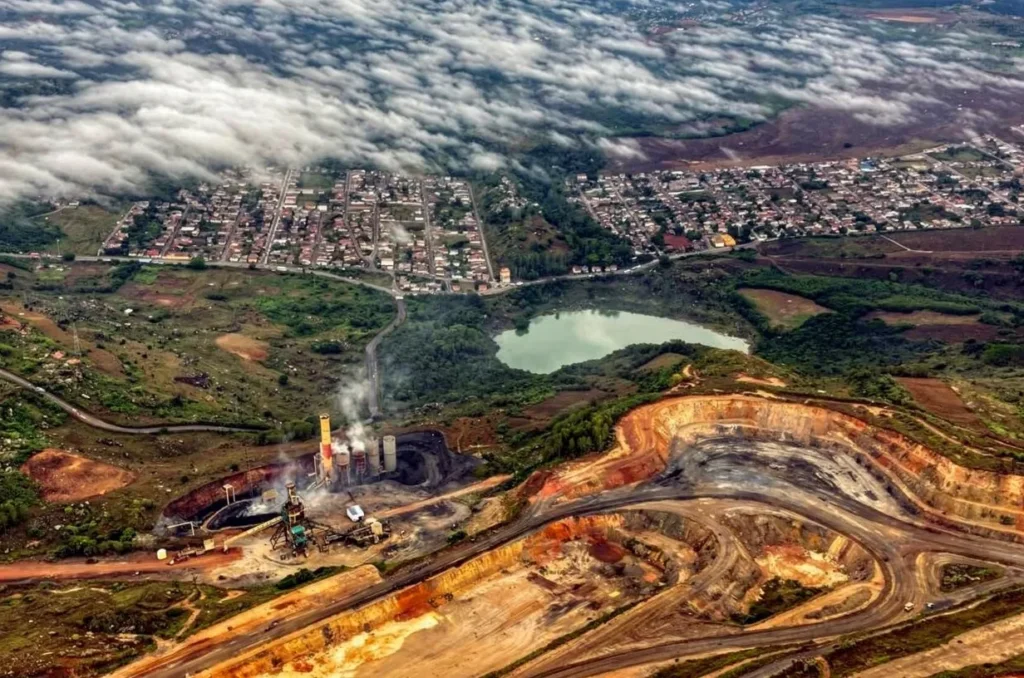
Earlier this month, the company completed its roughly $2.8 billion combination with Serra Verde, owner of the Pela Ema rare earth operation in Goiás. Serra Verde is currently the only scaled producer outside Asia of all four magnetic rare earths: neodymium, praseodymium, dysprosium and terbium.
But the more interesting part is what may come next.
USA Rare Earth has said it has not ruled out building additional downstream capabilities in Brazil. The company is already developing technology to turn Serra Verde’s mixed rare earth carbonate into separated products, while its wider platform includes metals, alloys and permanent magnets.
The Serra Verde supply chain also has significant U.S. backing. A government-supported special-purpose vehicle was capitalized at $1.55 billion, including a $750 million U.S. government investment, a $500 million senior debt commitment and a forward purchase agreement covering at least $300 million of rare earth products.
That structure is important.
The U.S. does not necessarily need every stage of every critical-minerals supply chain physically located within its own borders. It needs reliable supply chains outside Chinese control, built across countries where mining, processing and manufacturing can be secured.
Processing is becoming the real battleground
Finding a deposit is only the beginning.
A functional critical-minerals chain can require several distinct stages:
- Mining and beneficiation
- Chemical processing and separation
- Refining
- Metal and alloy production
- Permanent magnet or advanced-material manufacturing
China spent decades building capacity across those middle stages, which is why Western governments can discover new deposits without immediately eliminating their dependence on Chinese processing.
Brazil appears increasingly determined not to repeat the old model of simply exporting raw resources.
Australian developer St George Mining, for example, signed an agreement to study a 2 billion real, roughly $385 million, rare earth processing and separation center in Minas Gerais. Rare Earths Americas is also evaluating separation and potentially magnet manufacturing inside the country.
Brazil’s new policy framework offers another incentive. Eligible projects can receive tax credits of up to 20% for certain mineral processing and transformation expenditures, subject to annual limits and government approval.
The combination of large mineral resources, competitive energy, new incentives and growing Western demand could give Brazil a chance to become much more than a source of ore.
A new critical-minerals map is taking shape
The U.S. and Brazil have not finalized a broad federal critical-minerals agreement, and negotiations have faced disagreements over how investment and access should work. Yet corporate investment and state-level cooperation are moving ahead.
Goiás, home to Serra Verde and several other rare earth projects, has already signed a critical-minerals cooperation agreement with the U.S. aimed at areas ranging from mining and separation to alloys and permanent magnets.
American investment in Brazilian critical-minerals projects had already exceeded $600 million by March, according to former U.S. chargé d’affaires Gabriel Escobar, with officials suggesting the opportunity could eventually reach into the billions.
The significance extends beyond Brazil.
Western critical-minerals policy is increasingly moving away from a simple question of where the mineral is mined and toward a harder question: where can an entire non-Chinese supply chain actually be built?
Brazil has enormous resources. The U.S. has capital, customers and a strategic need to diversify. Mining companies increasingly want access to downstream margins rather than stopping at concentrate or mixed material.
If those pieces begin coming together, Brazil could emerge as one of the most important processing hubs in the Western critical-minerals supply chain.
And that may create opportunities far beyond the companies digging the mines.
Explore More Stories in Commodities
Disclaimer
Wall Street Access is an independent financial publisher. Wall Street Access is not a financial advisor. No company mentioned has compensated Wall Street Access for the preparation, publication or distribution of this article. This content is provided for informational and educational purposes only and is not investment advice or a recommendation to buy, sell or hold any security. Investing involves risk, including the possible loss of principal.
Prices, market capitalizations, financial figures and other market data are based on information available as of the date and time of publication and may change without notice. Information is drawn from public sources believed to be reliable but is not guaranteed to be complete or accurate. Opinions and expectations expressed are our own and may change as new information becomes available.
Readers should conduct their own due diligence and contact a licensed financial professional before making any investment decision. Past performance does not guarantee future results. Any material ownership interest or conflict of interest, where applicable, will be disclosed separately.