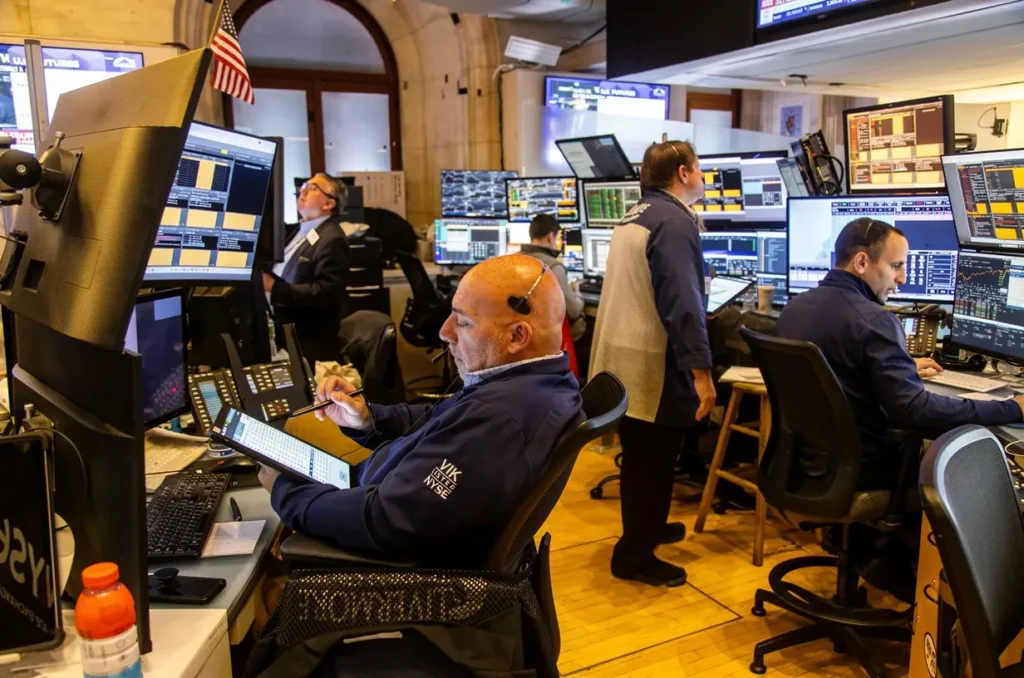

Wall Street split as investors rotated away from megacap technology
US stocks traded unevenly Thursday as stronger industrial and value shares lifted the Dow, while renewed inflation concerns and weakness in several large technology companies weighed on the Nasdaq.
The Dow Jones Industrial Average climbed roughly 1.4%, extending its recent outperformance against the technology-heavy indexes. The S&P 500 added around 0.5%, supported by gains across most major sectors.
The Nasdaq Composite gave up an earlier advance and slipped approximately 0.2%.
The divergence showed that investors were not broadly abandoning equities. Capital was moving away from some of the largest technology stocks and into parts of the market less exposed to elevated AI valuations and higher interest rates.
Inflation accelerated again in May
The Federal Reserve’s preferred inflation measure showed that price pressures continued to strengthen.
The headline Personal Consumption Expenditures price index rose 4.1% from a year earlier, up from 3.8% in April. Prices increased 0.4% from the previous month, slightly less than economists had expected.
Core PCE, which excludes food and energy, rose 3.4% annually, up from 3.3% in April. The monthly core reading increased 0.3%, compared with 0.2% the previous month.
The annual core rate was the highest since October 2023.
Energy prices contributed heavily to the headline increase following the disruption caused by the Iran conflict. The rise in core inflation was more significant for monetary policy because it showed that pressure was not limited to oil and gasoline.
The rate-hike debate remains active
The inflation report is unlikely to push the Federal Reserve toward an immediate policy change, but it keeps the possibility of another rate increase in the discussion.
Policymakers have already adopted a more cautious position after consumer and wholesale inflation readings moved higher. The latest PCE figures reinforce the argument for holding rates at restrictive levels until officials see clearer evidence that price pressures are easing.
Higher interest rates are particularly challenging for expensive growth stocks. Their valuations depend heavily on profits expected years into the future, making them more sensitive to changes in bond yields and discount rates.
The market’s reaction reflected that tension. Investors continued buying companies with strong earnings support while becoming less willing to reward high valuations based primarily on future AI expectations.
Micron delivered the confirmation the memory trade needed
Micron Technology reported record quarterly results and issued a stronger-than-expected outlook, providing clear evidence that demand for advanced memory remains strong.
The company’s shares jumped more than 10% after revenue and earnings exceeded Wall Street forecasts. Micron also disclosed approximately $22 billion in long-term customer commitments designed to secure memory-chip supplies.
Those agreements are especially important for high-bandwidth memory, which is used alongside advanced processors inside AI data centres.
The results helped answer one of the market’s most pressing questions following the recent global semiconductor selloff. Demand from large AI customers remains strong enough that buyers are committing capital years in advance to secure access to scarce components.
Memory and storage stocks rallied with Micron
Micron’s report lifted other companies connected to memory, storage and semiconductor equipment.
SanDisk advanced roughly 14%, while Western Digital gained around 4%. Applied Materials also moved higher, and the iShares Semiconductor ETF rose more than 2%.
The rally followed a volatile stretch in which investors had questioned whether AI infrastructure stocks had risen too far ahead of earnings.
Micron’s results supported the view that elevated valuations can remain defensible when revenue, margins and customer commitments continue exceeding expectations.
The report did not eliminate valuation risk across the semiconductor industry. It showed that the underlying demand for memory remains stronger than the recent stock-market volatility suggested.
Qualcomm is making a major move into data centres
Qualcomm added another positive development for the chip sector by outlining plans to expand beyond smartphones and into AI data-centre infrastructure.
The company expects the new business to generate more than $15 billion in annual revenue by fiscal 2029. Its planned product lineup includes processors, server systems, software and custom silicon designed for cloud and AI workloads.
Qualcomm shares rose as investors considered the possibility of a new growth engine outside its traditional mobile-chip business.
The strategy places Qualcomm in direct competition with Nvidia, AMD, Broadcom and several custom-chip programs operated by large cloud providers.
Its entry also reflects the scale of expected AI demand. Chip companies continue committing capital to new product categories despite concerns that the data-centre buildout may eventually produce excess capacity.
Nvidia slipped as competition widened
Nvidia shares moved lower even as the broader semiconductor group gained.
Micron’s results confirmed that AI infrastructure spending remains healthy, but Qualcomm’s expansion highlighted the growing competition surrounding data-centre computing.
Nvidia continues to dominate advanced AI processors and benefits from an extensive software and networking ecosystem. Its largest customers and semiconductor rivals are nonetheless developing more alternatives.
The market is beginning to separate continued growth in AI demand from the question of which companies will capture that growth.
A larger overall market can support several suppliers. It can also reduce the assumption that Nvidia will maintain the same share of every AI workload indefinitely.
Big Tech weakness limited the S&P 500 and Nasdaq
The strongest semiconductor earnings were not enough to produce a broad technology rally.
Several megacap companies moved lower, preventing the Nasdaq from holding its early gains. The weakness continued a recent pattern in which investors have become more selective across the largest AI and cloud-computing names.
That selectivity is becoming increasingly important for the major indexes. A small group of technology companies carries enough market weight to offset gains across dozens of smaller stocks.
Thursday’s session demonstrated that distinction. Market breadth was relatively constructive, but the headline Nasdaq performance looked weak because of concentrated pressure in its largest components.
Oil returned to prewar levels as Hormuz traffic improved
Crude prices remained near levels last seen before the Iran conflict.
Brent traded around $74 a barrel, while West Texas Intermediate held near $70 as more oil and commercial vessels moved through the Strait of Hormuz.
The renewed flow of tankers has reduced fears of a prolonged disruption to Gulf exports. More supply is becoming available, insurance conditions are improving and stranded vessels are beginning to leave the region.
Full normalization may still take months. Shipowners remain cautious after attacks during the conflict, and the long-term rules governing passage through Hormuz remain unsettled.
Lower crude prices should eventually reduce headline inflation and pressure on consumers, but the May PCE report captured the earlier energy spike. The inflationary relief from the recent oil decline will only appear in later economic data.
A stronger economy complicates the Fed’s decision
Revised data also showed that the US economy expanded faster in the first quarter than previously estimated.
Economic growth was revised to an annualized 2.1%, up from the earlier estimate of 1.6%.
Stronger growth reduces concerns about an immediate recession, but it also gives the Fed less reason to ease policy while inflation remains elevated.
The combination of persistent price pressure and resilient activity supports a higher-for-longer rate environment. Investors may continue rewarding companies with visible earnings growth while applying greater scrutiny to businesses whose valuations depend on distant expectations.
WSA Take
Thursday’s market was stronger beneath the surface than the Nasdaq suggested.
Micron delivered convincing evidence that AI memory demand remains robust, and Qualcomm introduced another potentially large data-centre growth platform. Those developments supported semiconductor suppliers and helped stabilize confidence after several volatile sessions.
The inflation report kept the broader technology trade from regaining full momentum. Headline and core PCE both accelerated, preserving the possibility that the Fed could hold rates higher for longer or tighten again if inflation fails to cool.
For now, the market is rotating rather than retreating. Investors are still willing to pay for AI growth when earnings justify it. They are becoming less willing to treat every large technology company as an automatic beneficiary.
Explore More Stories in Markets
Disclaimer
WallStAccess is a financial media platform providing market commentary and analysis for informational and educational purposes only. This content does not constitute investment advice, a recommendation, or an offer to buy or sell any securities. Readers should conduct their own research or consult a licensed financial professional before making investment decisions.