What Happened
U.S. stocks drifted into negative territory on Tuesday as investors tried to process three separate pressure points at once: Kevin Warsh’s Fed confirmation hearing, a major leadership change at Apple, and fresh uncertainty around the next phase of U.S.-Iran negotiations.
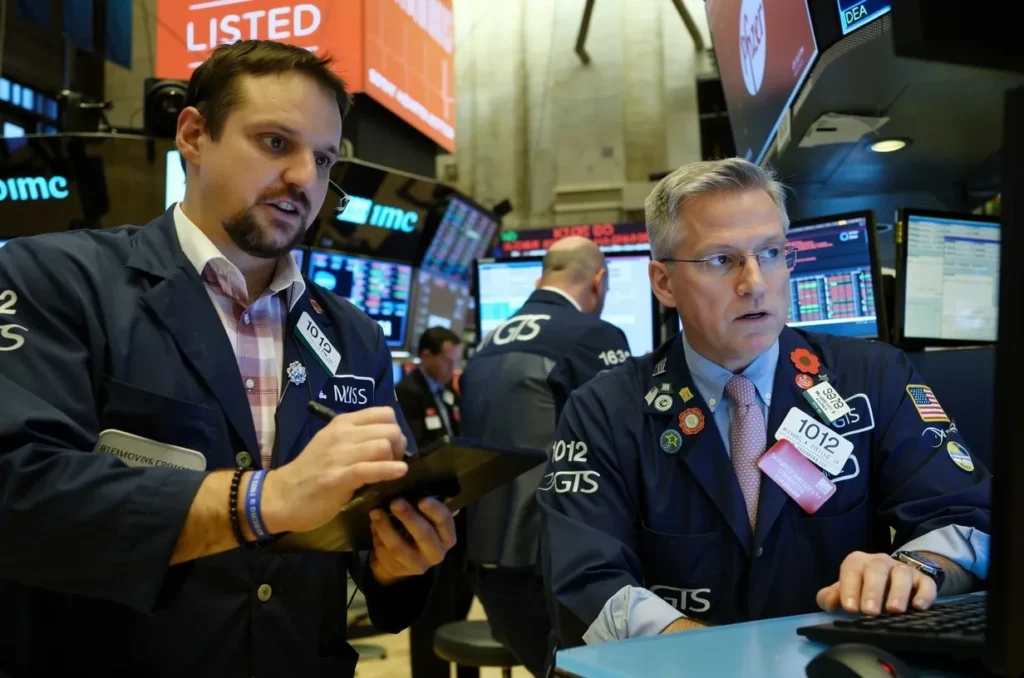
The Dow Jones Industrial Average fell 0.1%, the S&P 500 slipped 0.2%, and the Nasdaq Composite lost 0.1%. The move followed mild losses in the previous session and reflected a market that still looks uneasy about geopolitics, rates, and leadership transitions in some of its most important names.
Warsh Tried To Calm Fears Around Fed Independence
A major part of the day’s focus was Kevin Warsh’s confirmation hearing for the top job at the Federal Reserve.
Warsh pushed back against the idea that he would simply do whatever President Trump wants, saying he would not be the president’s “sock puppet.” That mattered because one of the market’s biggest concerns around his nomination is whether a Trump-backed Fed chair could maintain real independence if political pressure on rates intensifies.
For investors, that is not a minor issue. Fed credibility matters directly for:
- bond yields
- rate expectations
- equity valuations
- broader confidence in U.S. policymaking
Warsh’s comments may have helped on tone, but they did not fully remove the uncertainty around how a future Warsh-led Fed would operate under continued White House pressure.
Apple Added Another Layer Of Uncertainty
Markets were also digesting a major leadership change at Apple.
The source says Tim Cook will step down as CEO, handing the role to hardware engineering chief John Ternus. That is a significant moment for the company, given that Cook has led Apple through one of the strongest value-creation stretches in modern corporate history.
Even if the transition is orderly, leadership changes at a company like Apple matter because the market tends to ask a few immediate questions:
- does strategy change
- does execution stay as disciplined
- does product vision shift
- and does the company keep the same credibility with investors
That does not mean the transition is a negative in itself. But it does introduce fresh uncertainty into one of the market’s largest and most influential stocks.
Iran Risk Moved Back Up The List
The third major drag was renewed uncertainty around Iran.
According to the source, President Trump said U.S. negotiators are prepared to leave for Pakistan to resume talks, but he also signaled that the temporary ceasefire with Iran may not be extended when it expires late Wednesday.
That mixed message kept investors on edge.
On one hand, talks remain alive. On the other, Trump’s own rhetoric suggested the situation is still unstable. In the source, he said he is still looking for a deal, but also added that he expects to be “bombing” because he thinks that is “a better attitude to go in with.”
That kind of language matters because it makes it harder for markets to price a stable diplomatic path.
Oil Rose As Peace Talks Looked Less Certain
Energy markets reacted to that uncertainty immediately.
The source says Brent crude and WTI crude both rose roughly 4.5%, trading around $94.50 and $91.30 per barrel, respectively. The move was tied to reports that the White House had delayed Vice President JD Vance’s planned trip to Pakistan, which had been expected to support second-round peace talks.
That matters because the market was hoping the negotiations would help reduce the odds of another major energy disruption tied to Hormuz and the wider Middle East conflict.
Instead, Tuesday’s headlines suggested the diplomatic path may be getting more fragile again.
The Hormuz Blockade Is Still A Core Risk
Another reason oil stayed firm is that the Strait of Hormuz remains central to the entire market story.
The source says Iran has allegedly told mediators it would send a delegation only if the U.S. lifts its naval blockade. But Trump said Monday the blockade would stay in place until a deal is reached.
That leaves the market with a familiar problem: diplomacy may still be possible, but the most important real-world leverage point in the conflict remains unresolved.
As long as Hormuz stays tied to military and negotiating pressure, oil is likely to remain volatile, and equities are likely to stay sensitive to every new headline.
The Economic Data Was Stronger Than Expected
One of the more constructive parts of the day came from the consumer side.
The source says U.S. retail sales rose 1.7% in the latest monthly reading, the strongest increase in a year. That is a notable signal because it suggests consumers are still spending even as gasoline prices have pressured household budgets.
That kind of number is usually read as broadly supportive for the economy, especially in a market still trying to determine whether higher energy prices are starting to materially hurt demand.
The stronger retail sales figure suggests the consumer has not cracked yet.
But A Strong Consumer Can Also Complicate Rates
At the same time, stronger retail sales are not an unqualified positive.
When consumer demand stays firm in a market already worried about oil, inflation, and Fed policy, it can also reinforce the idea that the economy is not slowing enough to make life easier for policymakers.
That is part of why the market reaction stayed mixed-to-negative. Investors got a sign of economic resilience, but not necessarily a sign of an easier macro backdrop.
A stronger consumer plus elevated oil can still be a complicated mix for rates.
United Airlines Is The Next Useful Read-Through
Another name in focus is United Airlines, which reports after the bell.
That matters because airlines are one of the clearest near-term read-throughs on:
- fuel costs
- travel demand
- consumer resilience
- and margin pressure from energy markets
If war-driven oil prices stay high, airlines are among the sectors most directly exposed. That makes United’s commentary more important than usual, especially in a week where investors are trying to judge whether the latest energy spike will stay contained or broaden into a bigger macro problem.
This Market Still Looks Headline-Driven
Tuesday’s session was another reminder that the market is still trading off a mix of macro and headline risk rather than one clean theme.
Investors are balancing:
- uncertainty around the next Fed chair
- a major Apple leadership transition
- and a still-fragile Iran negotiation track
That kind of setup tends to create hesitant trading, especially when stocks are already near elevated levels and oil is pushing higher again.
WSA Take
Tuesday’s move lower was not about one single shock. It was about the market having to absorb too many unresolved variables at once. Warsh tried to calm concerns around Fed independence, but the nomination still leaves open real policy questions. Apple’s CEO transition adds uncertainty to one of the market’s most important stocks. And the Iran situation still looks unstable enough to keep oil and inflation risk alive.
For investors, the key signal is that this market still needs clarity more than it needs good headlines. Until the path around rates, Apple leadership, and Middle East diplomacy gets cleaner, stocks may keep struggling to build sustained upside momentum.
Explore More Stories in Markets
Disclaimer
WallStAccess is a financial media platform providing market commentary and analysis for informational and educational purposes only. This content does not constitute investment advice, a recommendation, or an offer to buy or sell any securities. Readers should conduct their own research or consult a licensed financial professional before making investment decisions.