The market gave SpaceX exactly the debut investors expected
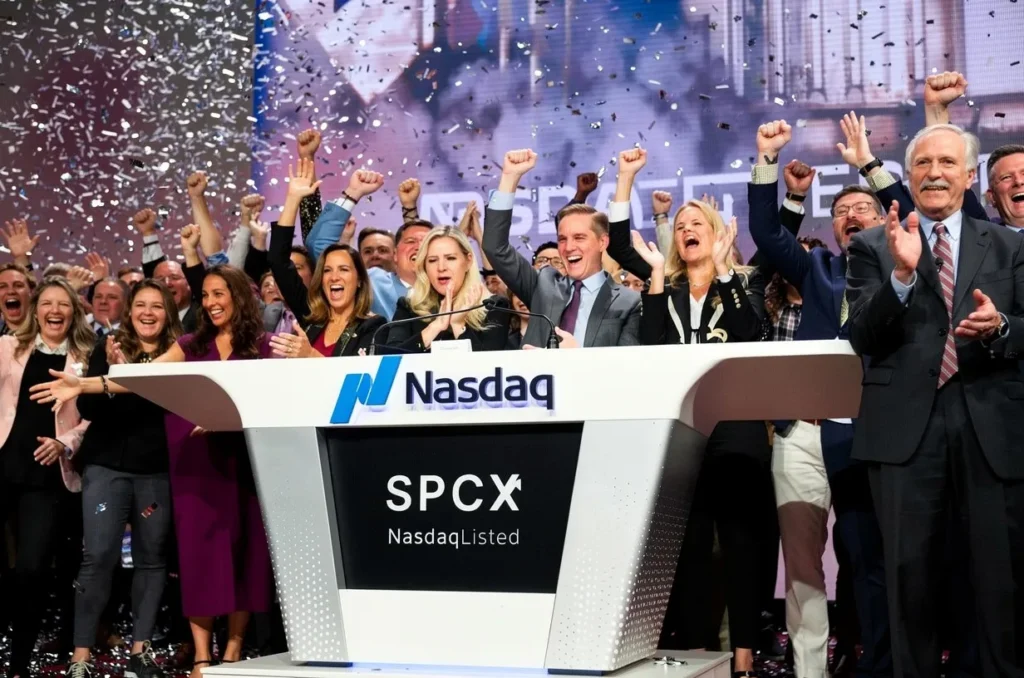
SpaceX opened trading Friday at $150 under the ticker SPCX, a sharp move above its $135 IPO price. Within the first stretch of trading, the stock pushed through $160 and later reached the mid-$170s, putting the company’s valuation above $2 trillion. Reuters described the debut as a record-breaking IPO and one of the clearest signs yet of how much risk appetite still exists for large, narrative-driven technology listings.
The IPO was historic on size alone
SpaceX raised $75 billion in the offering, making it the largest IPO ever and more than doubling the previous global record set by Saudi Aramco. At the offering price, the deal valued the company at roughly $1.77 trillion. Reuters also reported that SpaceX allocated an unusually large 30% of the IPO to retail investors, a factor that likely contributed to the strength of the first-day move.
The market is buying the next phase, not the current income statement
The first-day surge says less about near-term profitability than it does about investor willingness to fund the next chapter of the story.
Reuters reported that SpaceX generated about $18.7 billion in revenue in 2025 and posted a $4.94 billion loss last year. The company’s only consistently profitable segment remains Starlink, while the broader business continues to absorb large amounts of capital across launch, satellite infrastructure, AI, and next-generation space systems.
That is the trade now. Investors are not buying current earnings power. They are paying for scale, scarcity, and the belief that SpaceX can become a much larger strategic platform over time.
Starlink is still doing most of the heavy lifting
The most commercially mature part of SpaceX today is still Starlink.
Reuters said Starlink remains the primary revenue engine and the only profitable division inside the broader company structure. That matters because it gives investors at least one operating business with visible traction while the rest of the story remains tied more to long-term execution and capital spending.
The market clearly views that segment as the financial foundation under a much larger ambition.
The IPO also says something about the market, not just SpaceX
This debut is larger than one company.
Reuters noted that the deal lands at the front of what is increasingly being treated as a new wave of mega-tech offerings, with Anthropic and OpenAI also moving toward the public market. A successful first day for SpaceX strengthens the case that institutional and retail demand is still deep enough to absorb enormous new issuance, especially when the company sits at the center of the market’s most powerful themes: AI, communications infrastructure, and industrial-scale technology.
The valuation debate is not going away
The size of the debut will sharpen, not settle, the valuation debate.
Reuters reported that some analysts continue to question whether the company’s numbers justify its public-market price, especially given its losses, heavy capital needs, and concentrated voting control. That tension was always going to define the listing. SpaceX is not being valued like a conventional aerospace or telecom company. It is being valued as a strategic platform with multiple future businesses embedded inside it.
That may work very well over time. It also means volatility is likely to remain part of the stock’s identity from the beginning.
WSA Take
SpaceX’s debut did exactly what a mega-IPO is supposed to do in a market like this: it pulled in capital, attention, and momentum all at once.
The opening pop confirmed that investor appetite for rare, large-scale technology assets remains strong. The harder question comes next. Once the excitement of the debut passes, the stock will need to hold up against the same pressures that hit every oversized growth story: valuation, execution, dilution risk, and the sheer cost of building what management says it wants to build.
Disclaimer
WallStAccess is a financial media platform providing market commentary and analysis for informational and educational purposes only. This content does not constitute investment advice, a recommendation, or an offer to buy or sell any securities. Readers should conduct their own research or consult a licensed financial professional before making investment decisions.