Ukraine’s urgent need meets America’s production calendar
A crowded railway platform in Dnipro became another scene of destruction on October 29. Ukrainian officials said a Russian drone strike killed at least 14 people. Elsewhere, missile attacks continued threatening the infrastructure Ukrainians depend on for electricity, heating and water.
The following day, Washington approved a possible $2.1 billion sale of 500 PAC-3 Missile Segment Enhancement interceptors for Ukraine’s Patriot defenses.
Ukraine needs protection now. The new missiles still need to be built.
People briefed on the decision said deliveries were not expected until the early 2030s. Kyiv is seeking faster access, potentially through transfers from existing American stocks that would later be replenished with newly manufactured interceptors.
The proposed purchase would use contributions from Canada, Germany and Norway through the JUMPSTART program, together with Ukrainian funds financed by the European Union’s Ukraine Support Loan. The package includes missiles, spare parts and support. It is an approved possible sale, rather than confirmation that 500 finished missiles are ready for shipment.
The gap between approval and delivery leads directly into America’s industrial challenge: expanding weapons production requires every essential component to arrive, pass inspection and perform reliably.
That challenge extends from missile assembly plants to the minerals used in specialized components.
What happens after a Patriot crew detects a threat
A Patriot defense begins working before an interceptor leaves its launch canister.
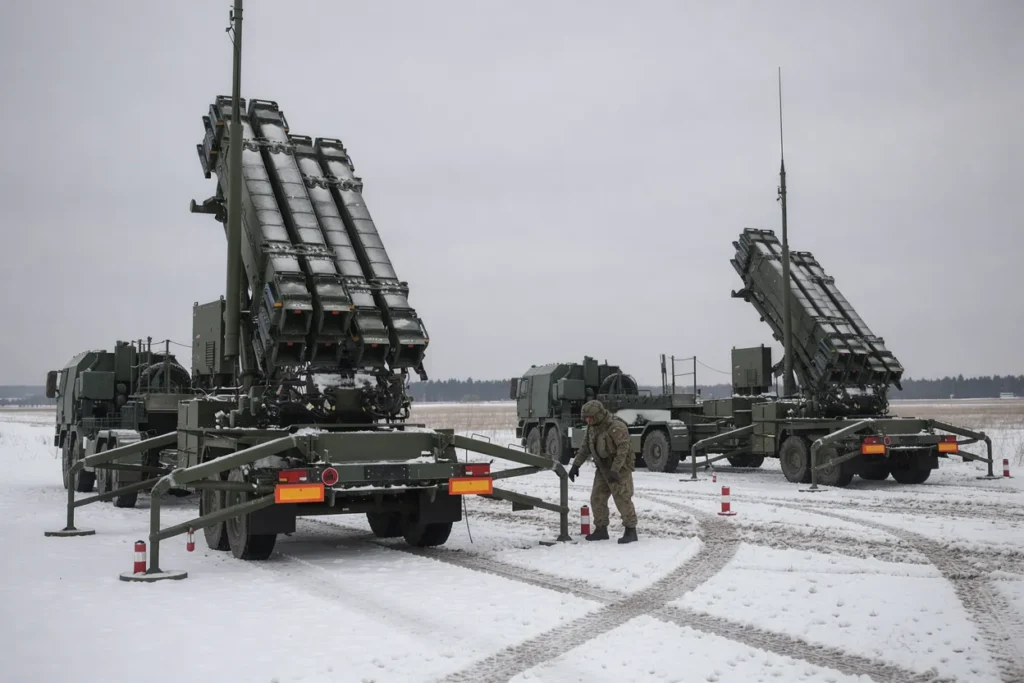
Ground-based radar detects and tracks an approaching threat. A command station processes the information and coordinates the engagement. Launchers positioned around the defended area hold the interceptor missiles that can be fired against it.
Patriot is an interconnected system, combining radar, communications, command equipment, power supplies and launchers. RTX is the principal contractor for the broader system; Lockheed Martin manufactures the PAC-3 MSE interceptor involved in Ukraine’s proposed purchase.
Once launched, the interceptor accelerates toward its target. Its onboard seeker provides the information needed to identify and track the threat during the engagement. Steering components and small attitude-control motors help make the rapid adjustments required for interception.
The PAC-3 MSE uses hit-to-kill technology: it is designed to strike the incoming threat directly. Its two-pulse solid rocket motor, upgraded actuators and larger fins improve its reach and maneuverability.
That precision requires many specialized parts to work together under demanding conditions. Once an interceptor is expended, another manufactured and tested missile must take its place.
The defense opportunity is spreading through the factory network
Lockheed Martin is expanding production to meet that demand. In July, a new award brought the total value of its multiyear PAC-3 MSE contract to up to $58.62 billion, supporting plans to triple capacity by the end of 2030.
The spending reaches beyond the company assembling the finished interceptor.
| Company | Role in PAC-3 MSE production | Disclosed award |
|---|---|---|
| Lockheed Martin (LMT) | Interceptor integration and production | Multiyear contract value up to $58.62 billion |
| Boeing (BA) | Seekers that identify and track threats | Approximately $14.7 billion |
| L3Harris (LHX) | Propulsion and related missile components | $4.7 billion over seven years |
Boeing’s award supports a tripling of seeker production. L3Harris is expanding propulsion manufacturing, including two Camden, Arkansas, facilities expected to become operational in 2027. These supplier awards form part of the production chain and should not be added to Lockheed’s headline contract as separate total government spending.
For investors, this provides evidence of a defense expansion reaching multiple industrial layers. The opportunity includes companies that can supply the components and materials needed to support larger production runs.
Rare-earth materials represent one strategic dependency within that network. Public reporting does not establish that they caused the delivery schedule for Ukraine’s particular order.
Small magnets can carry a large supply risk
Inside military equipment, permanent magnets help electric motors and actuators turn electrical commands into precise movement. Army research identifies their use in missile fin actuators, guidance and control equipment, radar and other defense systems.
Two important magnet families use different rare-earth ingredients:
- Neodymium-iron-boron, or NdFeB: strong, compact magnets using primarily neodymium and praseodymium. Certain grades also contain dysprosium or terbium to improve performance at elevated temperatures
- Samarium-cobalt, or SmCo: magnets using samarium, a rare-earth element, together with cobalt. Their resistance to heat and demagnetization makes them useful in demanding military applications
The distinction matters. A national NdFeB demand estimate cannot automatically be applied to every missile or substituted for samarium-cobalt requirements.
The Commerce Department describes typical NdFeB magnets as approximately 30% rare earths, 69% iron and 1% boron by weight.
The simple composition calculation is:
1 metric ton of finished NdFeB magnets × 30% = approximately 300 kilograms of rare-earth metals.
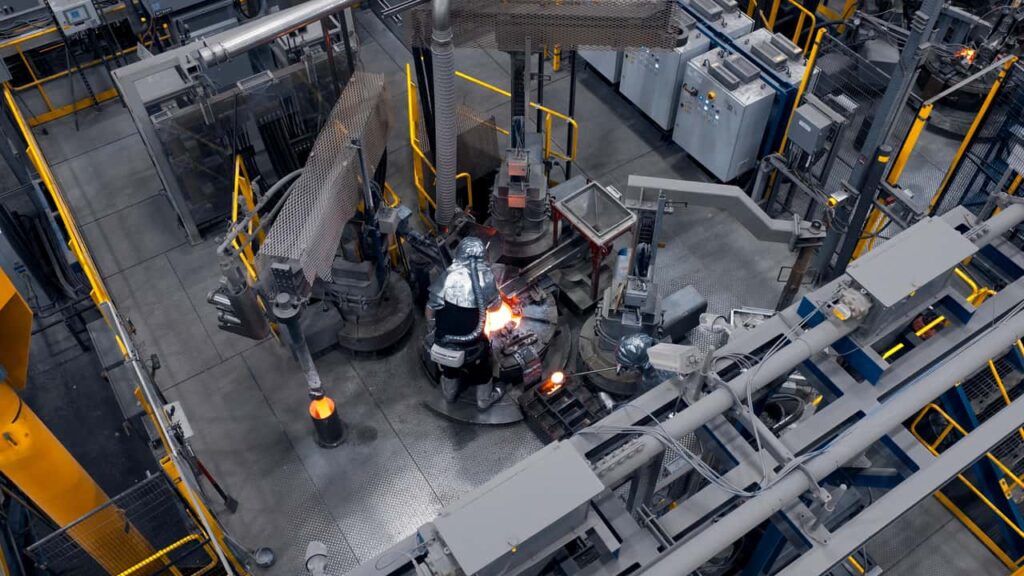
Those metals must be separated, processed, alloyed and manufactured into magnets with the required properties. Finding rare-earth-bearing material is the beginning of that process.
Subscribe to Read on the Company We’re Watching in this Sector
America’s magnet gap is much larger than one missile order
In 2025, U.S. demand for the most common rare-earth magnet type was approximately 48,000 metric tons, while domestic sources supplied only 300 metric tons, according to Arthur D. Little figures reported by Reuters.
The subtraction is straightforward:
48,000 metric tons of demand − 300 metric tons of domestic supply = a 47,700-metric-ton gap.
Domestic supply covered approximately 0.6% of estimated demand, leaving about 99.4% uncovered by domestic production. These are economy-wide figures encompassing civilian and defense applications.
That gap indicates dependence on foreign supply, but it is not a measured customs total. Magnets also enter the country inside motors, machinery and other finished products.
China sits at the center of this exposure. McKinsey identifies China as the principal source of U.S. neodymium-containing magnet imports in 2025. The Congressional Research Service estimates that China manufactures approximately 94% of rare-earth-based magnets globally.
Building American missile factories therefore addresses only part of the industrial challenge. Reliable upstream materials and magnet manufacturing must expand alongside them.
January brings a stricter test of where materials come from
On January 1, 2027, defense acquisition restrictions become more demanding.
Existing rules already restrict covered magnets melted or produced in covered countries. The 2027 requirements extend restrictions upstream to mining, refining and separation, with detailed provisions covering the supply chain through finished magnet production.
China is among the covered countries, alongside Russia, Iran and North Korea. Both NdFeB and samarium-cobalt magnets fall within the rules.
The practical consequence is greater pressure to establish where materials originated and how they were processed. Moving final manufacturing elsewhere does not necessarily establish a compliant supply chain.
The restrictions govern covered defense acquisitions. Specified exceptions and nonavailability determinations remain available, and compliant allied suppliers can participate.
With less than two months remaining, the deadline adds urgency to sourcing decisions. New mineral projects, however, still require technical development, financing, permitting and customer qualification. Their potential contribution extends beyond the January deadline.
The next part of this story leads to Texas
Expanding weapons production and tighter sourcing requirements are creating a stronger case for domestic rare-earth supply.
Texas is already building part of that chain. MP Materials’ Independence facility in Fort Worth houses rare-earth metal, alloy and magnet manufacturing capabilities. Those operations need reliable supplies of suitable materials.
We’re watching one rare-earth company in a particular Texas district that we believe deserves a closer look as this market develops. Our upcoming coverage will examine its project, technical progress and the milestones that could shape its potential.
Ukraine’s need begins with interceptors ready to launch. The investment opportunity could reach much further upstream, toward the materials American factories need to keep producing them.
Disclaimer
Wall Street Access is an independent financial publisher. Wall Street Access is not a financial advisor. No company mentioned has compensated Wall Street Access for the preparation, publication or distribution of this article. This content is provided for informational and educational purposes only and is not investment advice or a recommendation to buy, sell or hold any security. Investing involves risk, including the possible loss of principal.
Prices, market capitalizations, financial figures and other market data are based on information available as of the date and time of publication and may change without notice. Information is drawn from public sources believed to be reliable but is not guaranteed to be complete or accurate. Opinions and expectations expressed are our own and may change as new information becomes available.
Readers should conduct their own due diligence and contact a licensed financial professional before making any investment decision. Past performance does not guarantee future results. Any material ownership interest or conflict of interest, where applicable, will be disclosed separately.